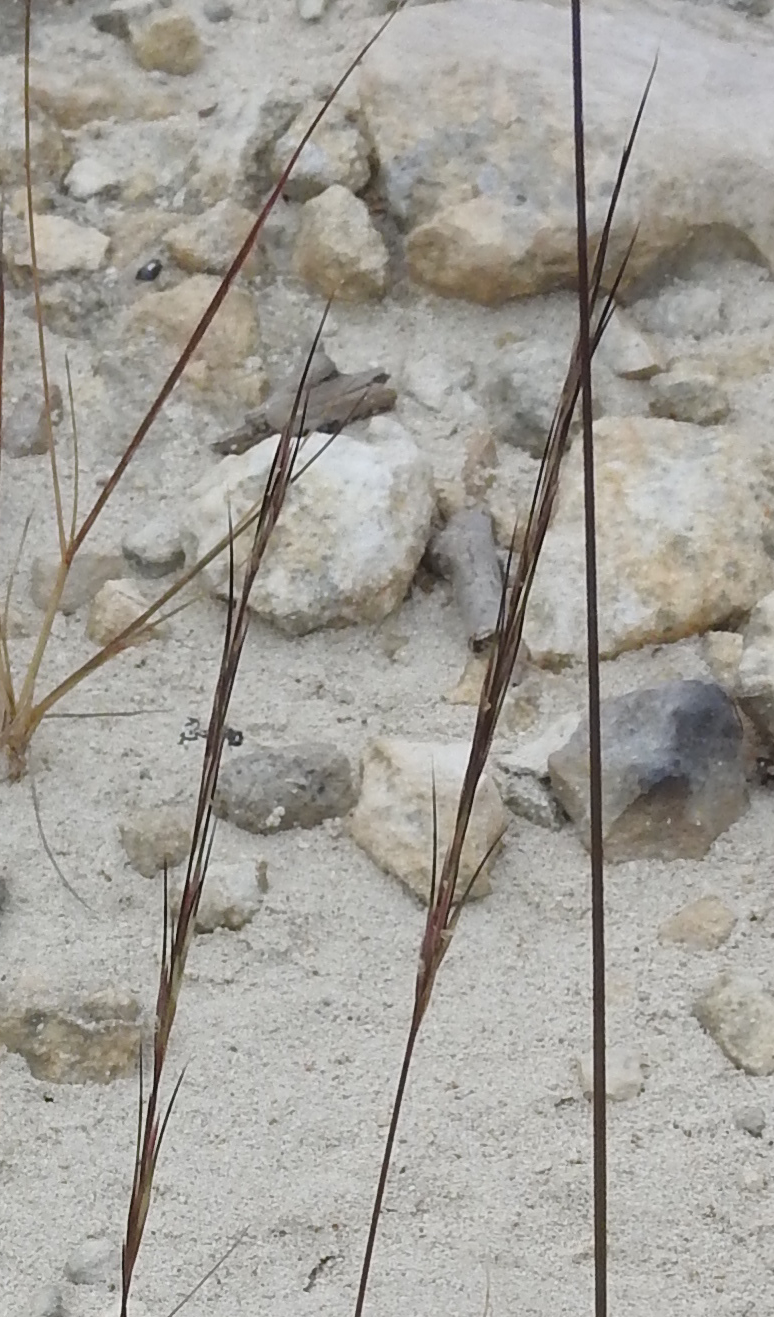
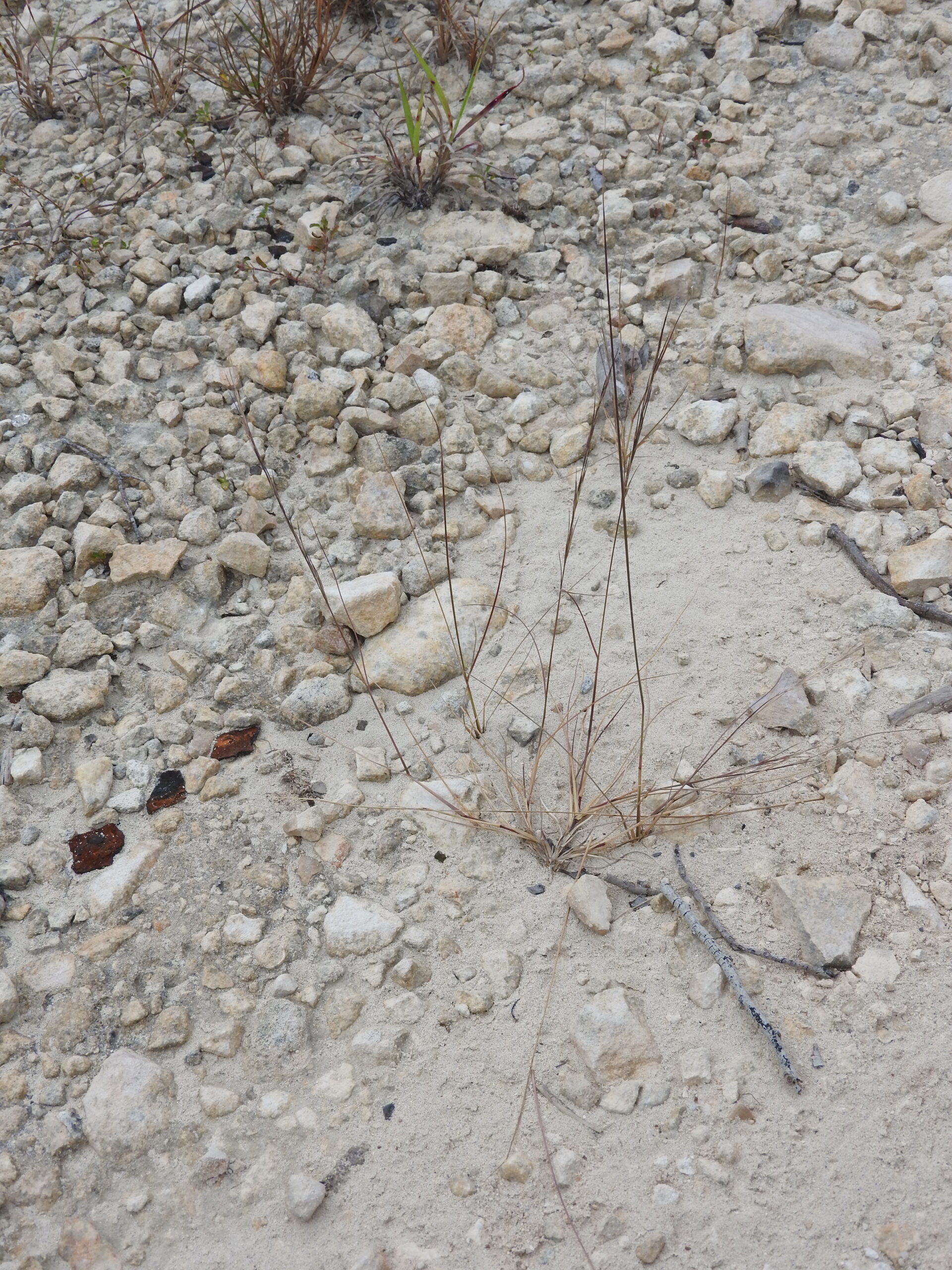
Habit: Aristida correlliae grows as a glabrous, dense clumping perennial to 50 cm in height when flowering with unbranched stems. The conduplicate leaves are arranged alternately, to 25 cm in length (much shorter towards the stem apex) and up to 2 mm wide with a basal sheath extending along the stem. At the point of divergence of the glabrous leaf sheath to the leaf blade is a fine ciliate ligule. The leaves are parallel veined and the lower portions of the leaf blade toward the stem are adaxially finely pubescent.
The zygomorphic flowers are arranged in an erect raceme made of 2-20 appressed, sessile spikelets. At the base of each spikelet are 2, short awned, structures called glumes. The first glume small and the second larger. In each spikelet there are flowering structures each is subtended by 2 additional structures (lemma and palea). The tip of the lemma has 3 erect awns that are of equal length. There are 3-5 florets with 3 stamens and a superior ovary each with a single locule and seed. The fruit is a caryopsis.
Habitat: Aristida correlliae grows on open ground on exposed limestone in Dry Broadleaf Evergreen Formation – Shrublands (open scrublands).
Distribution: Aristida correlliae is endemic to the Lucayan Archipelago. It is known to occur in the Turks and Caicos Islands and Long Cay (Fortune Island) near Crooked Island.
Medicinal/Cultural/Economic usage: Arisitda correlliae is not known to be used medicinally in the Lucayan Archipelago.