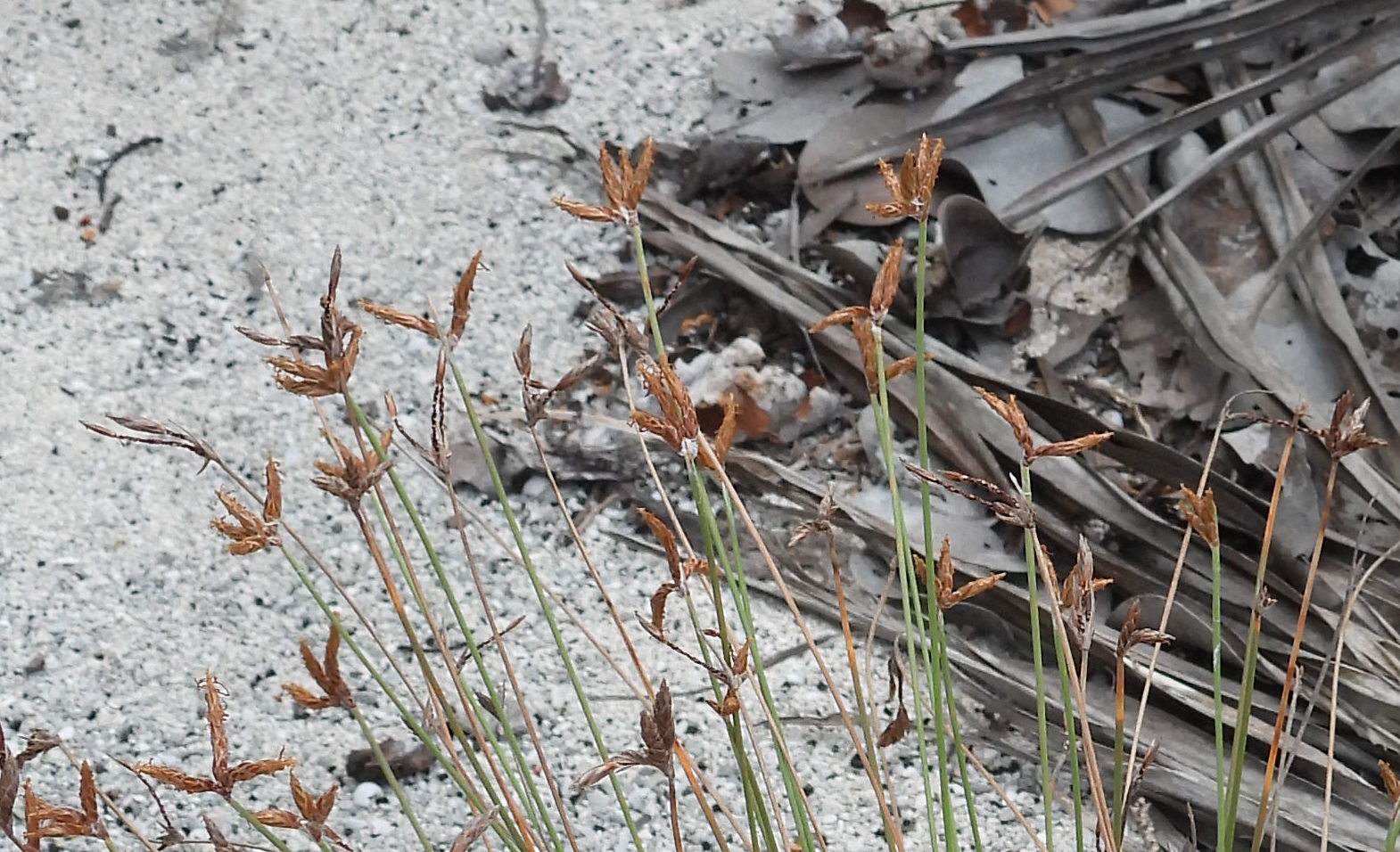
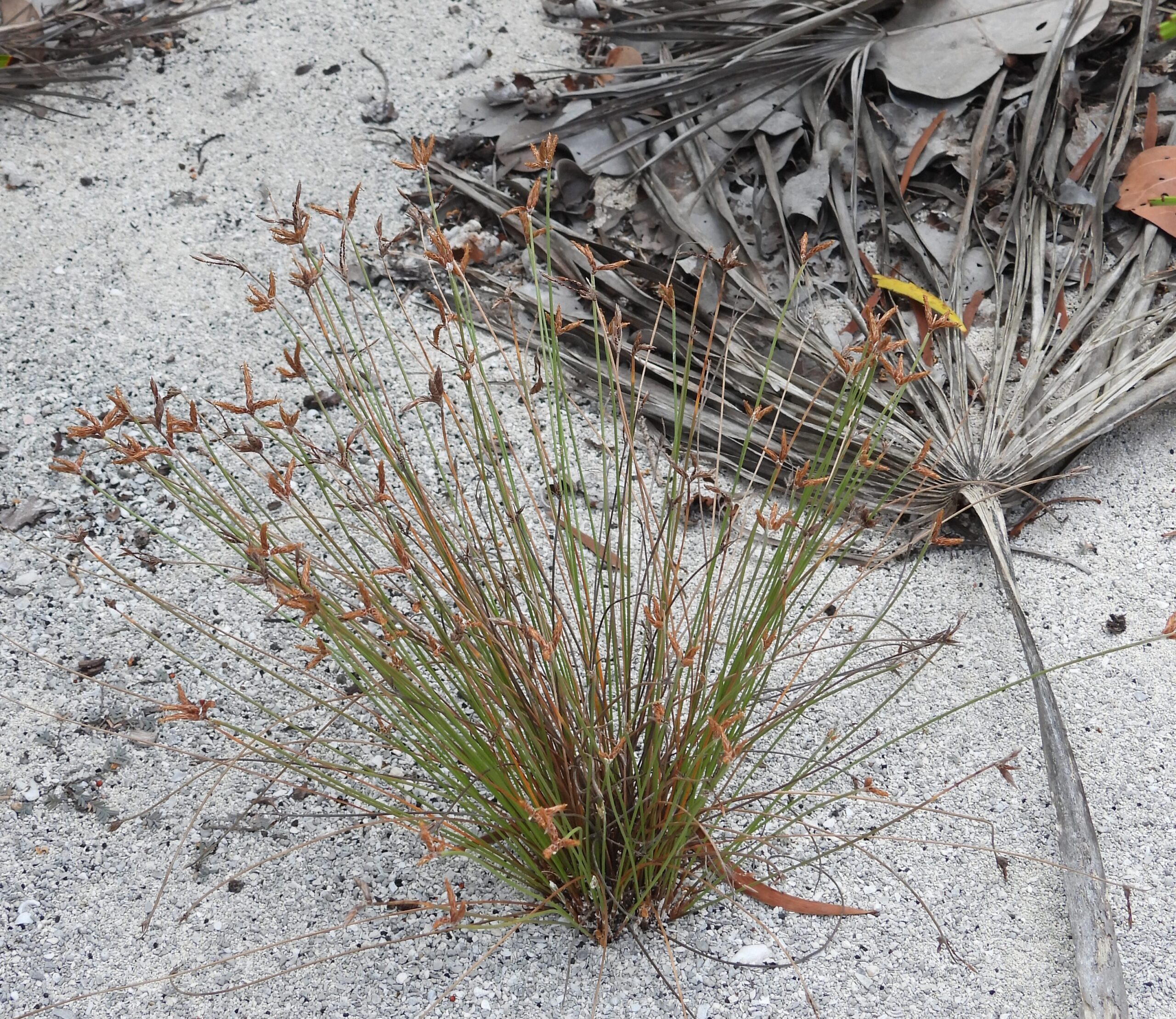
Habit: Bulbostylis floccosa grows as a clumping perennial herb to 40 cm in height when in flower, with a roundish stem. Leaves small and plants essentially bladeless with photosynthetic stems.
The incomplete, perfect flowers are arranged in a terminal cluster of 2-5 flattened spikelets. The spikelets are at the end of a triangular shaped peduncle and are subtended by a bract which is an extension of the stem. The flowers are subtended by ovate, ciliate/pubescent, brown bracts with a yellow to green midvein. There is no calyx or corolla. There are 3 stamens. The ovary is superior with a single locule with a 3-parted style. The fruit is an obovate achene at maturity.
Habitat: Bulbostylis floccosa grows in sandy soils near coastlines and in Coccothrinax Woodlands.
Distribution: Bulbostylis floccosa is native to the Lucayan Archipelago occurring in the southern Bahamas, Cuba, and Hispaniola.
Medicinal/Cultural/Economic usage: Bulbostylis floccosa is not known to be used medicinally in the Bahamas.