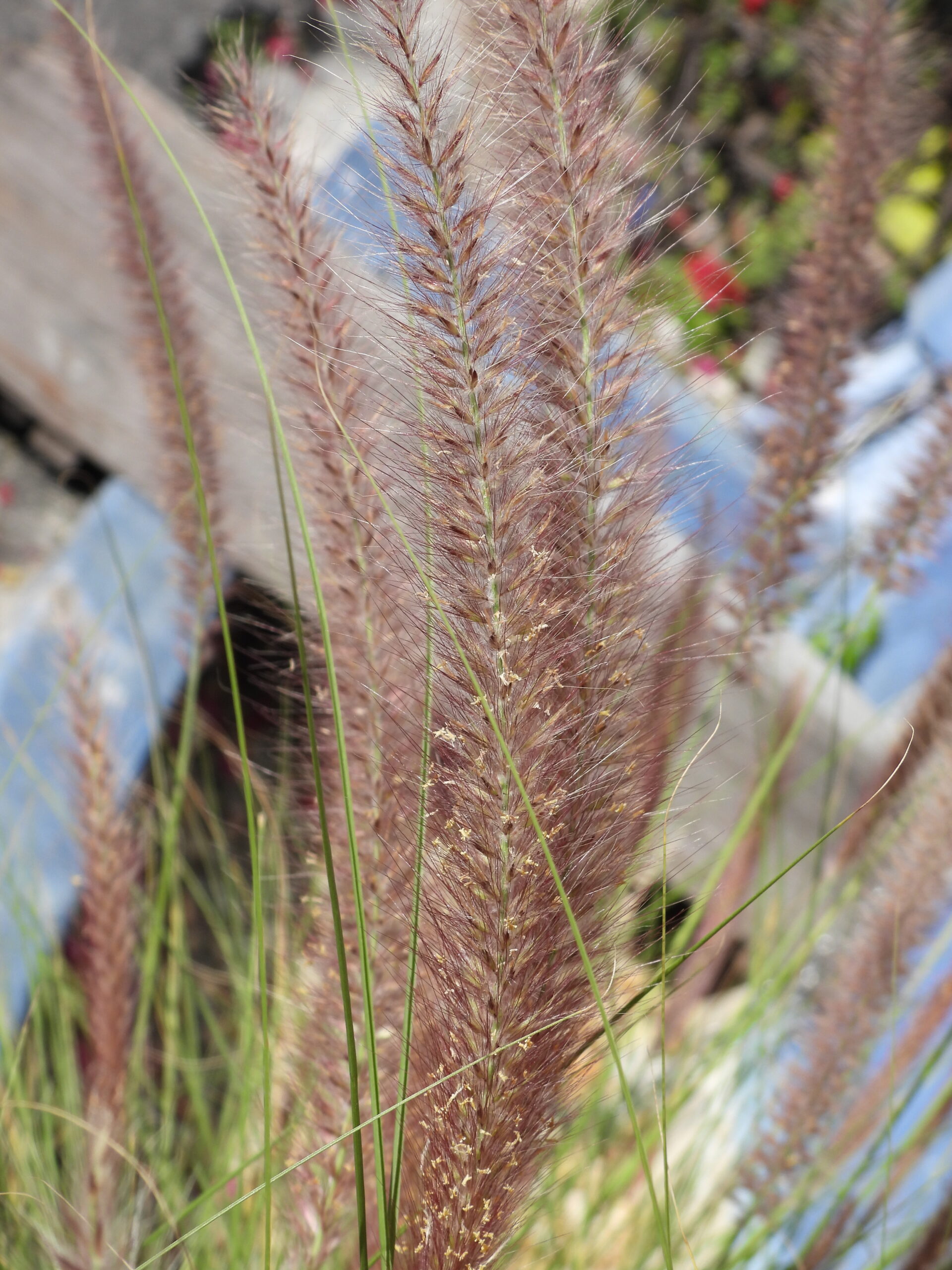
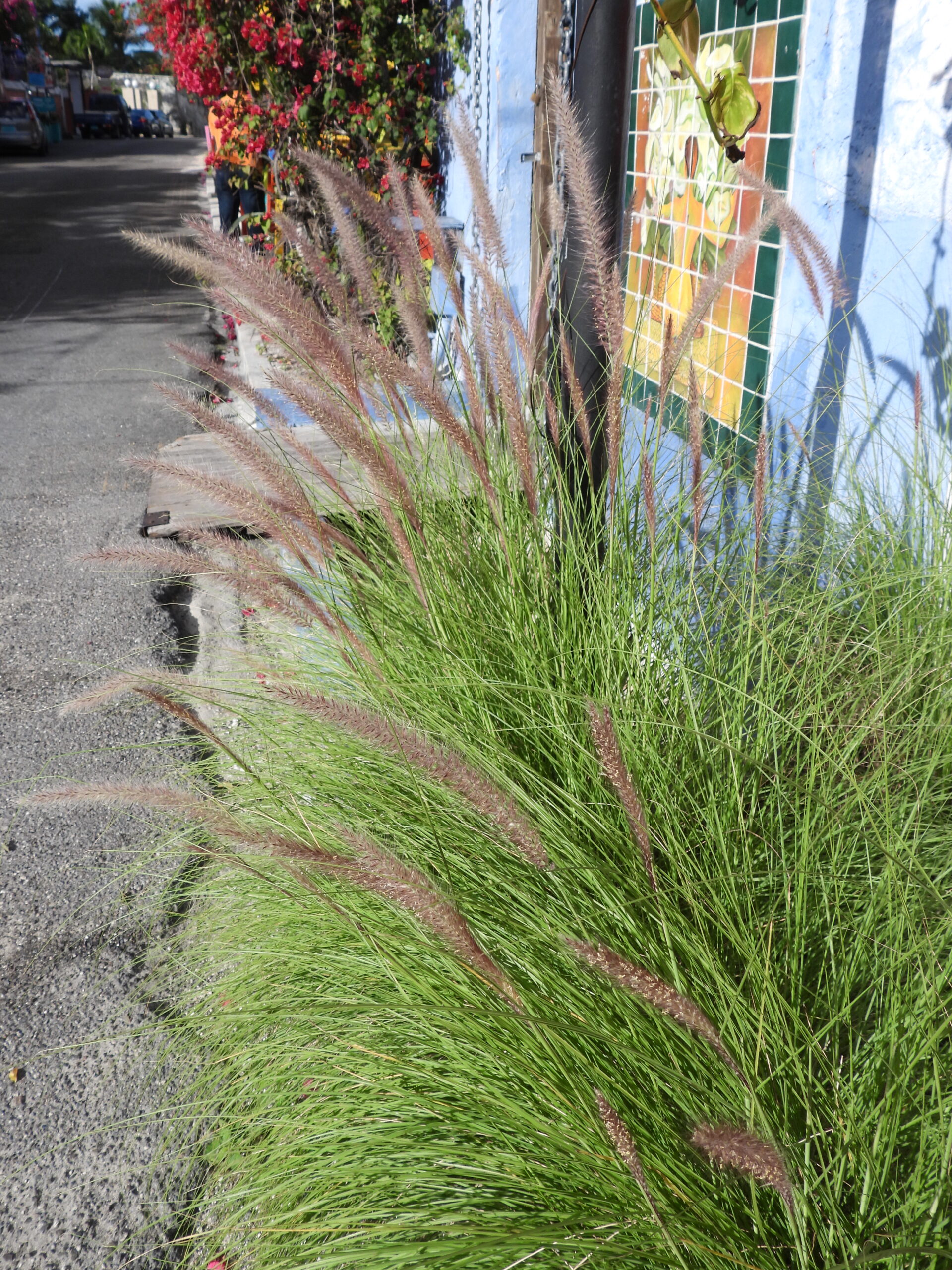
Habit: Cenchrus alopecuroides grows as an erect clumping perennial to 125 cm in height when in flower. The leaves are arranged alternately with a sheath extending along the stem that is pubescent along its edge. At the point of divergence of the leaf sheath to the leaf blade is a ciliate ligule. The leaves are parallel veined and to 90 centimeters in length and up to 1 cm wide at the point of divergence. The leaves turn yellow as they age.
The imperfect, incomplete, zygomorphic flowers are arranged in a terminal racemose, pubescent, lax, panicle. The flowers are highly modified without identifiable structures such as the calyx or corolla. Each flowering unit is a spikelet at the base of which are 2 yellow brown structures called glumes. In the spikelet, there are 2 flowering structures each is subtended by 2 additional structures (lemma and palea).
The entire spikelet surrounded by, connate at the base, bristled bracts. The bristles can be pink to red to purple to silvery in color and be up to 3 cm in length; producing a feathery appearance to the inflorescence. In each flower within the spikelet there are 3 stamens. The fruit is a caryopsis at maturity.
There are many cultivated varieties that have been bred with different colored inflorescences.
Habitat: Cenchrus alopecuroides grows in the Bahamas in Human Altered environments (gardens, yards, display beds).
Distribution: Cenchrus alopecuroides is not native to the Lucayan Archipelago. It is native to China, southeast Asia and Australia
Medicinal/Cultural/Economic usage: Cenchrus alopecuroides is not known to have been used medicinally in the Bahamas.
It is planted as an ornamental for its showy and colorful inflorescences.