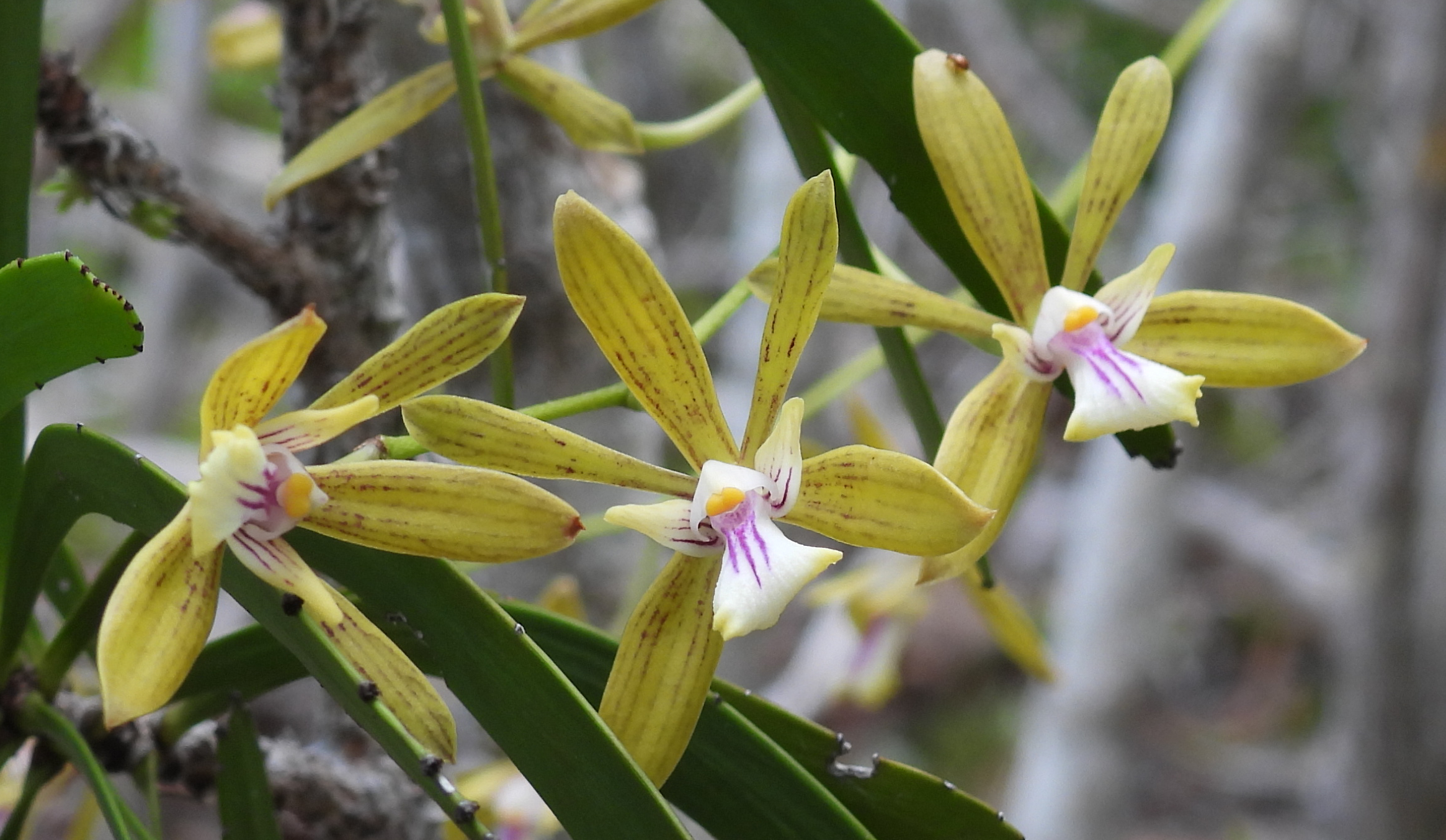
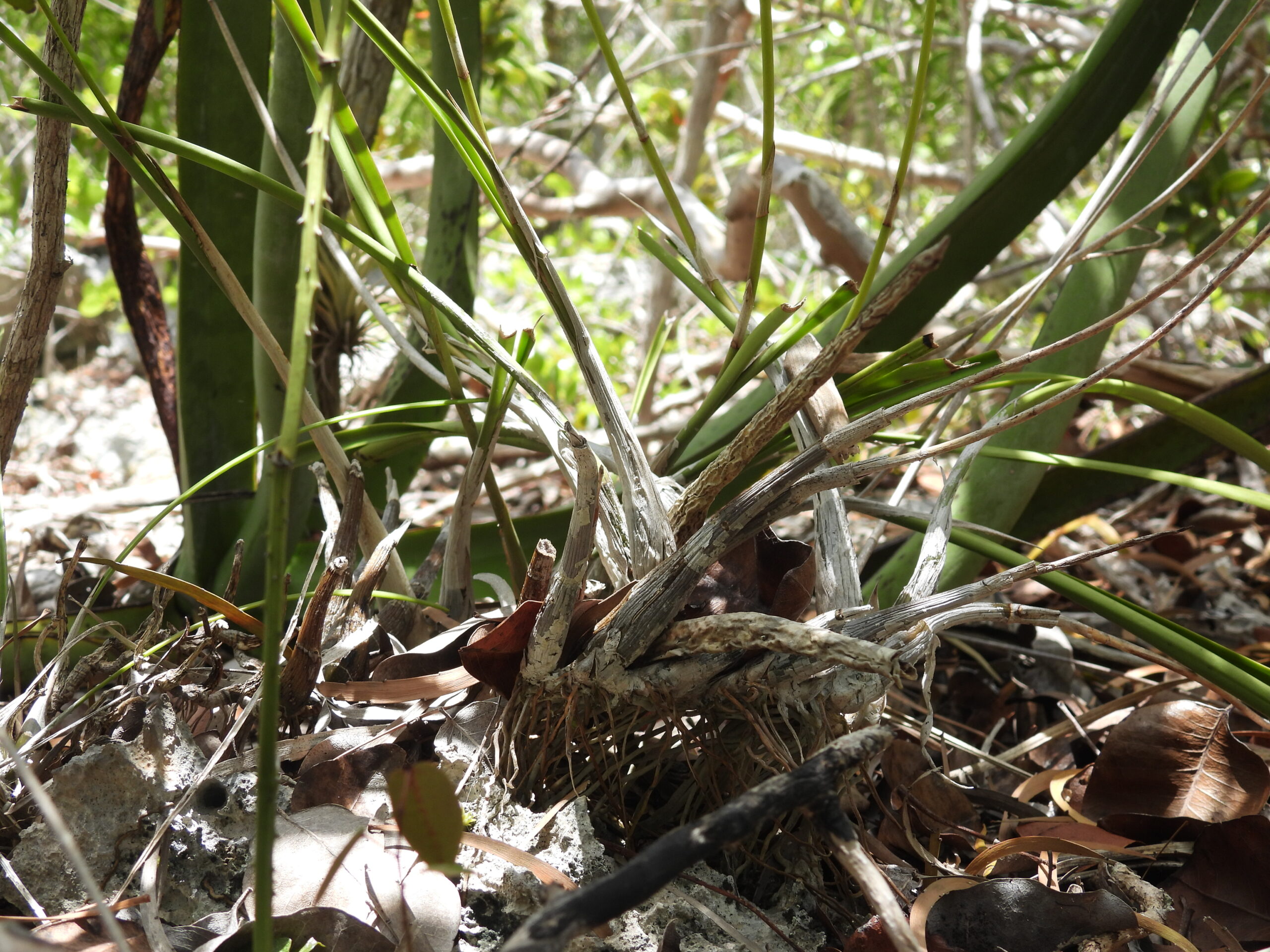
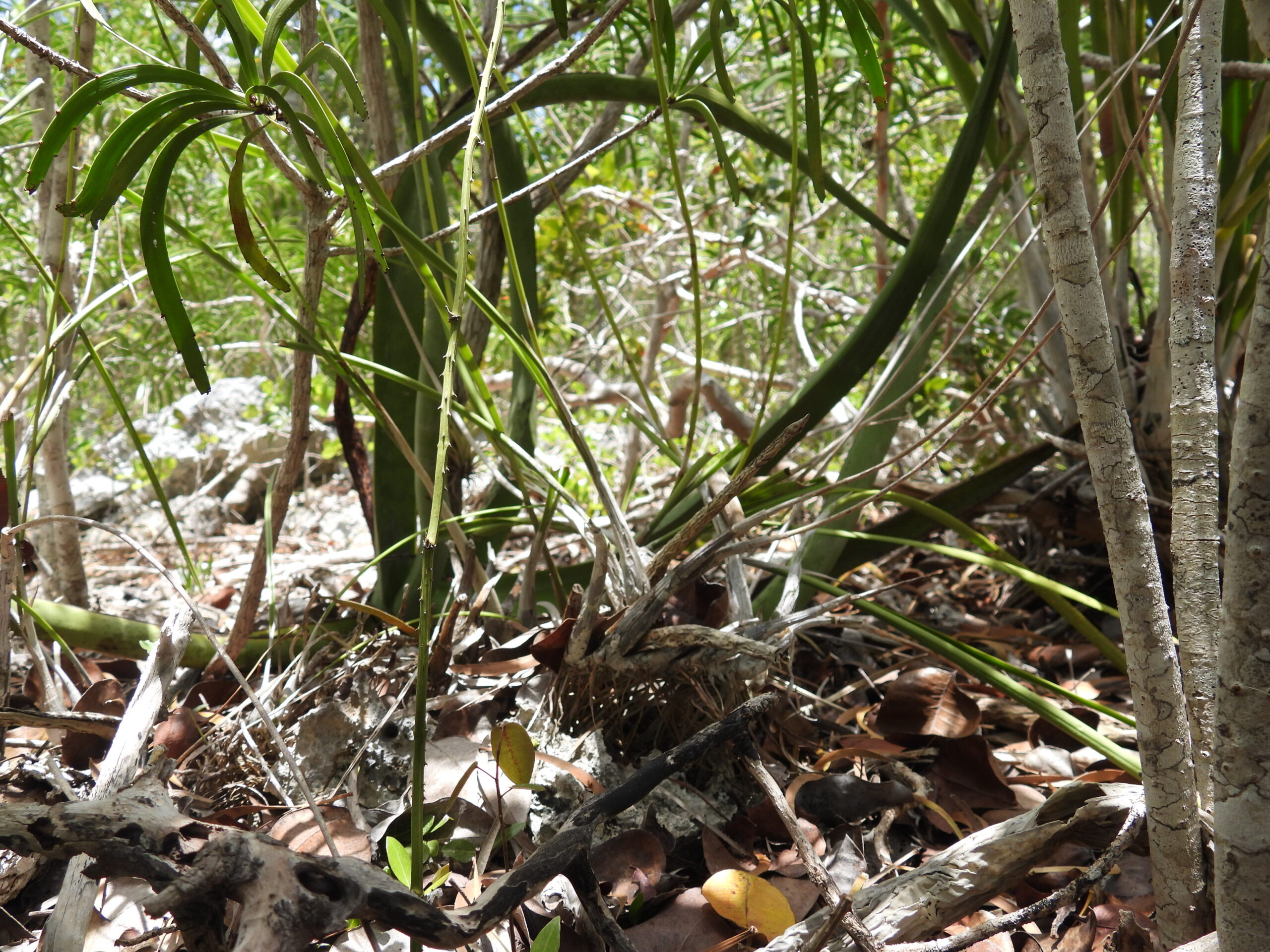
Habit: Encyclia inaguensis grow as an epiphyte on plants and directly on limestone. It produces a very short rhizomatous stem that is covered with secondary stems that are expanded to form linear lanceolate pseudobulbs up to 30 cm in length and 3 cm in width. From the top of the pseudobulb 2 flattened linear lanceolate leaves emerge that are up to 60 cm in length and 1.5 cm wide.
The zygomorphic flowers are arranged in terminal open panicles up to 150 cm in height and contains up to 50 flowers. The flowers have ovate-triangular bracts and the calyx has 3 green to brown to reddish brown sepals. The corolla has 3 green to brown to reddish brown petals with lower central one forming the labellum. The sepals and petals develop stripes with age.
The labellum is white, with purple stripes, and 3 lobed. The central lobe is to 2 cm long. The 2 lateral lobes/auricles of the labellum are white with yellow tips and with radiating purple red lines at their base and ascending away from either side of the column. The central lobe of the labellum is white with a yellow edge, an undulate margin and purple stripes. The lower third of the labellum is fused to the column.
The column is formed from a fusion of the stamens and ovary into a single elongate structure. Along the base of the column between the lateral labellum lobes is a ridged callus plate with 2 lobes/teeth at the front edge with the yellow anthers.
The ovary is inferior. The fruit is a capsule at maturity up to 3 cm in length that opens along six suture lines and hangs pendulant, allowing wind to assist in seed dispersal.
Habitat: Encyclia inaguensis grows in open Dry Broadleaf Evergreen Formation – Shrublands/Dwarf Shrublands (low open coppice).
Distribution: Encyclia inaguensis is endemic to the Lucayan Archipelago known only to Little Inagua and the Turks and Caicos Islands.
Medicinal/Cultural/Economic usage: While there are no medicinal uses of Encyclia inaguensis like all orchids they are prized for their beautiful flowers.
ALL orchids are protected internationally by the Convention on the International Trade of Endangered Species (CITES) and should not be collected from the wild.
Encyclia inaguensis is listed as Near Threatened (NT) under IUCN criteria B1b(iii)+2b(iii).
Barker, A., Naqqi Manco, B., Prosper, D., Blaise, J. & Corcoran, M.R. 2026. Encyclia inaguensis. The IUCN Red List of Threatened Species 2026:e.T138221530A138221565.
https://dx.doi.org/10.2305/IUCN.UK.2026-1.RLTS.T138221530A138221565.en