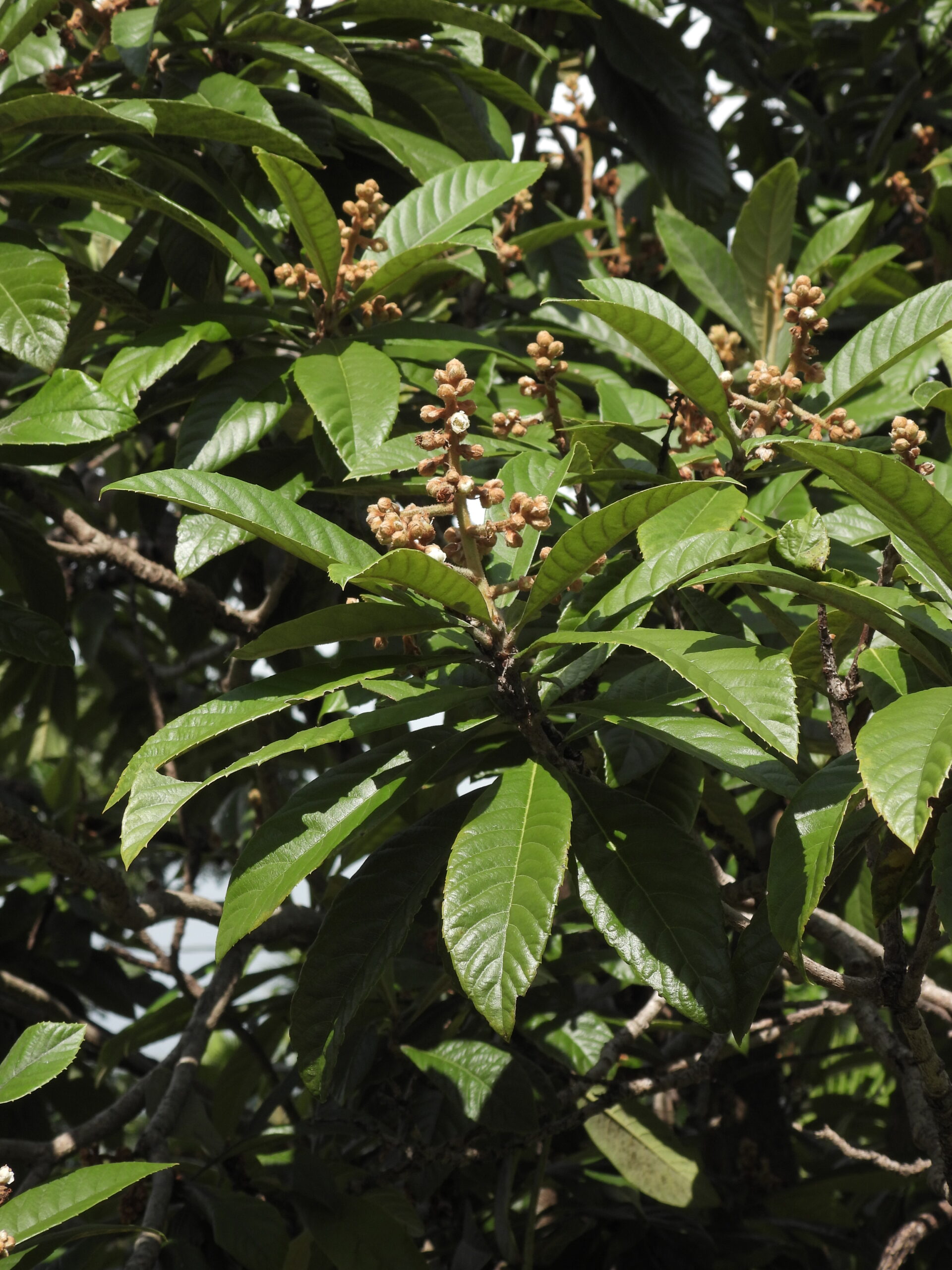
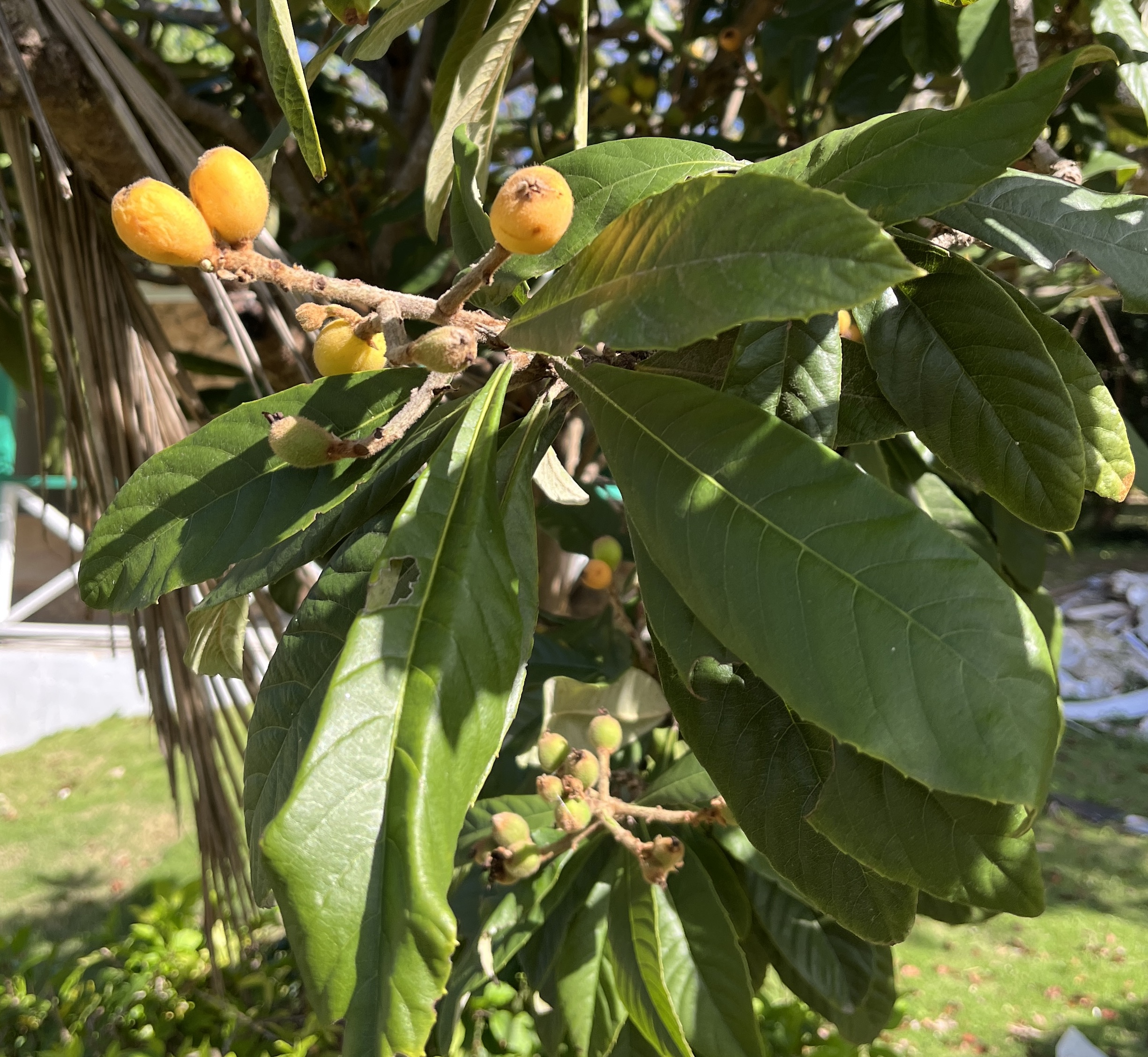
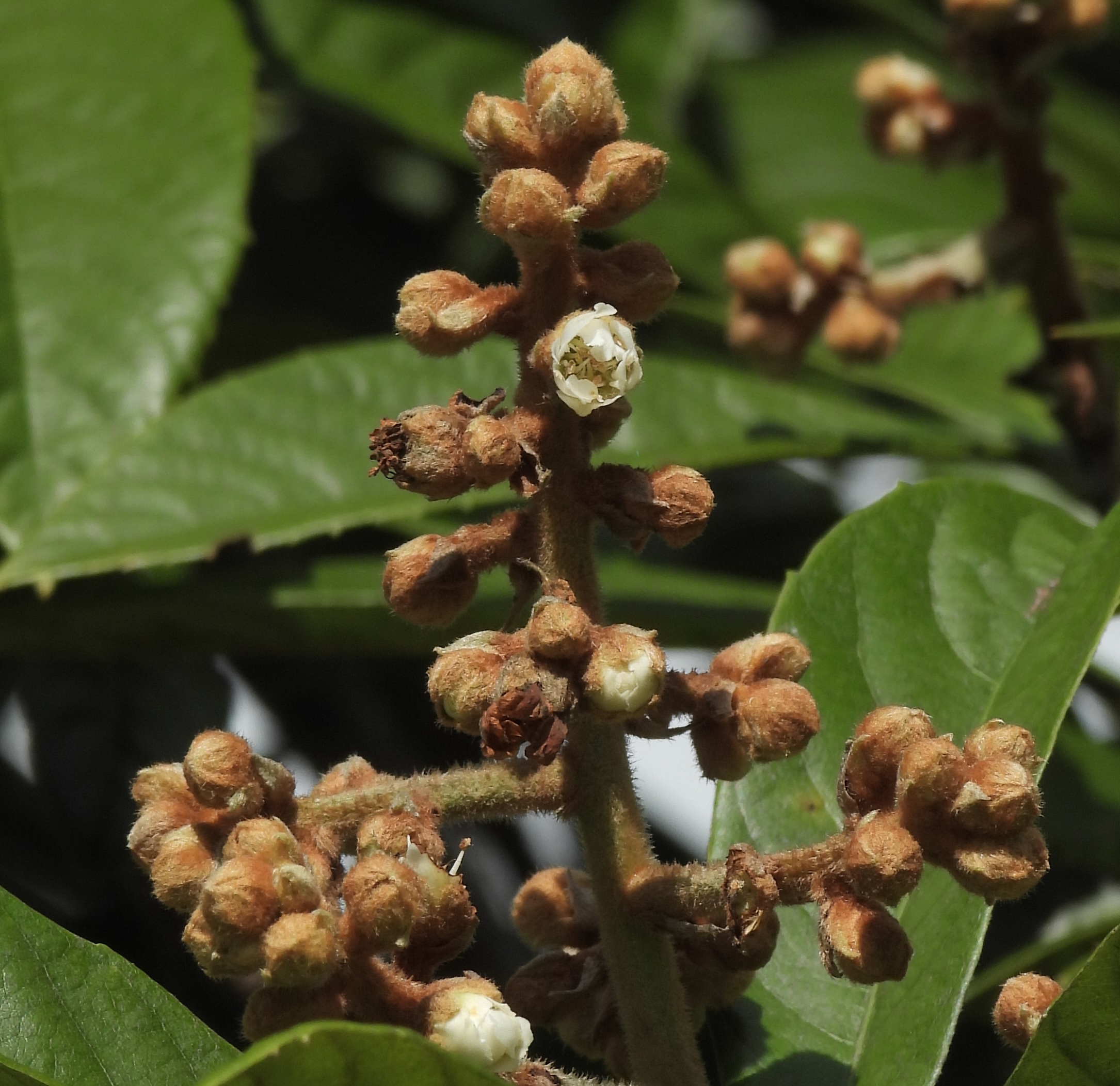
Habit: Eriobotrya japonica grows as a tree to 10 meters in height with smooth bark. Young vegetation tawny pubescent. The dark green leaves are arranged alternately, to 30 cm in length, lanceolate to oblanceolate with a leaf margin that is serrulate/dentate toward the apex, with an obtuse or acute leaf apex, and subtended by acuminate stipules. The leaves are abaxially pubescent while the adaxial surface is pubescent only during leaf development.
The complete, perfect, actinomorphic, flowers are arranged in open panicles. The base of the calyx, corolla, and the stamens are fused together to form a hypanthium. The calyx has 5 green sepals. The corolla has 5 white petals. There are 20 tomentose, white stamens. The ovary is superior with 5 locules each with 2 ovules. The fruit is an ovoid pome that is yellow to orange at maturity with 2-3 brown seeds.
Habitat: Eriobotrya japonica grows in the Bahamas in Human Altered environments (yards, farms, orchards).
Distribution: Eriobotrya japonica is not native to the Lucayan Archipelago. It is native to China. It is grown globally in temperate and subtropical regions.
Medicinal/Cultural/Economic usage: Eriobotrya japonica is not used medicinally in the Bahamas.
The fleshy fruit is sweet and edible.