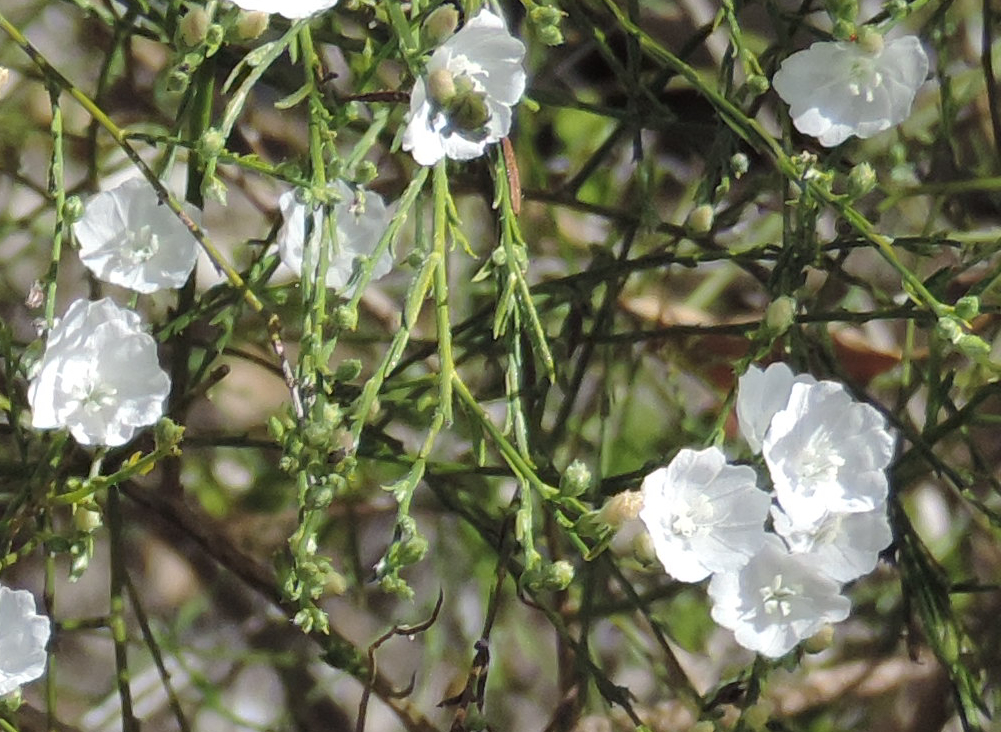
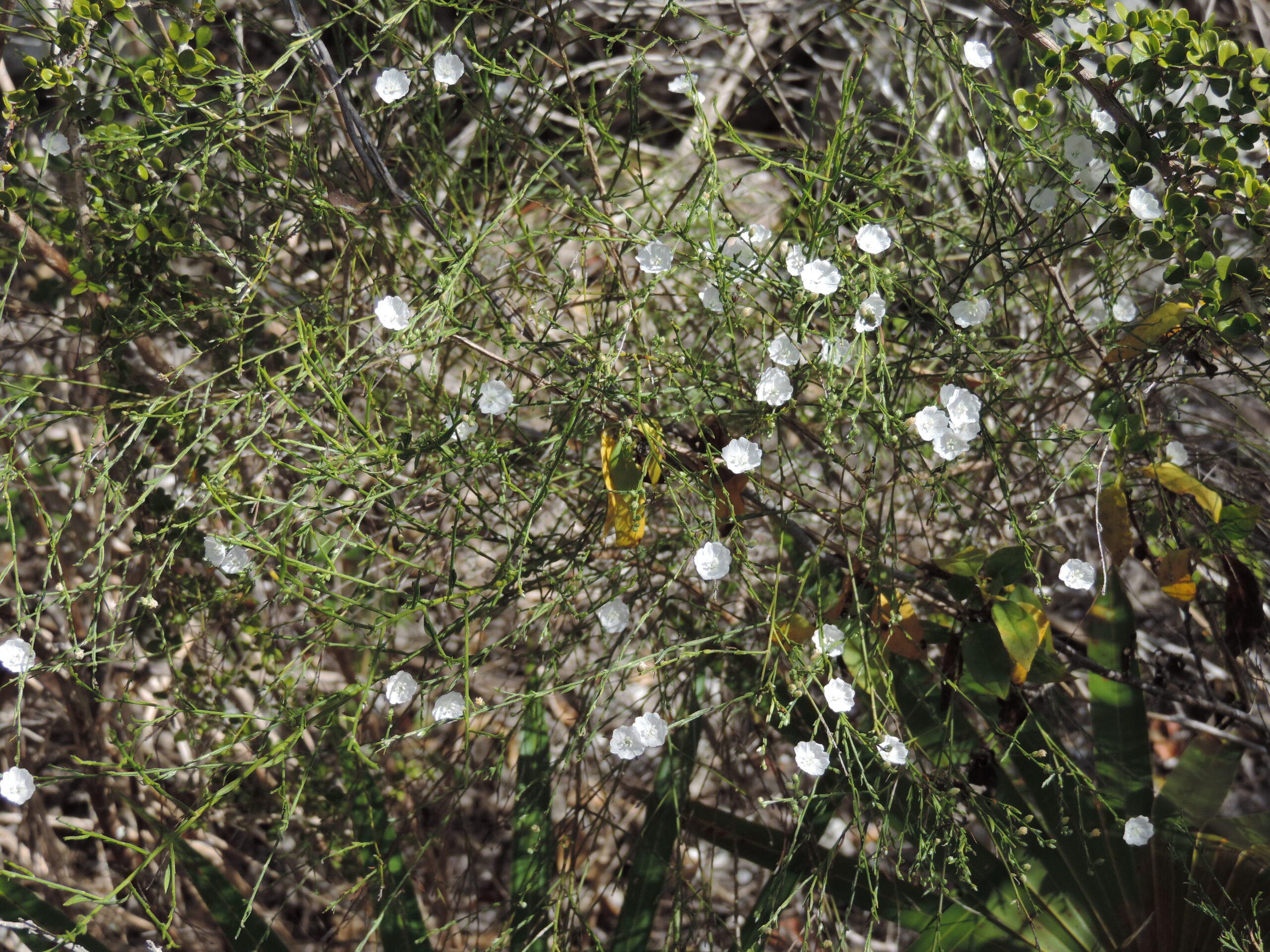
Habit: Evolvulus bahamensis grows as a low, highly branched shrub becoming basally woody, to 50 cm in height. The leaves are arranged alternately, sessile, narrow lanceolate/linear, to oblanceolate, to 1 cm long and 4 mm wide with an entire margin, an acute leaf apex and leaf base. Leaves become scale like toward the stem apex. Vegetation sparsely pubescent.
The complete, perfect, actinomorphic flowers are solitary in leaf axils. The calyx has 5 unfused, green sepals. The sharply funnelform corolla has 5 fused, light blue to purple/dark petals, sometimes white. There are 5 functional stamens fused to the base of the corolla and 5 staminodes. The superior ovary with 2 locules and numerous ovules. The round fruit is a round, tan, many seeded, pubescent capsule with brown seeds.
Habitat: Evolvulus bahamensis grows in open limestone areas in Dry Broadleaf Evergreen Formation – Shrubland (scrubland, dwarf shrublands).
Distribution: Evolvulus bahamensis is endemic to the Lucayan Archipelago occurring in the central and southern islands. It was originally considered only on the Turks and Caicos Islands but herbarium specimens have been observed from throughout the southern Bahamas.
Correll and Correll (1982) treat this as a variant of the Greater Antilles species E. arbuscula Poir but recent work considers it distinct (Acevedo and strong 2012) as its own species.
Medicinal/Cultural/Economic Usage: Evolvulus bahamensis is not used medicinally in the Bahamian Archipelago.