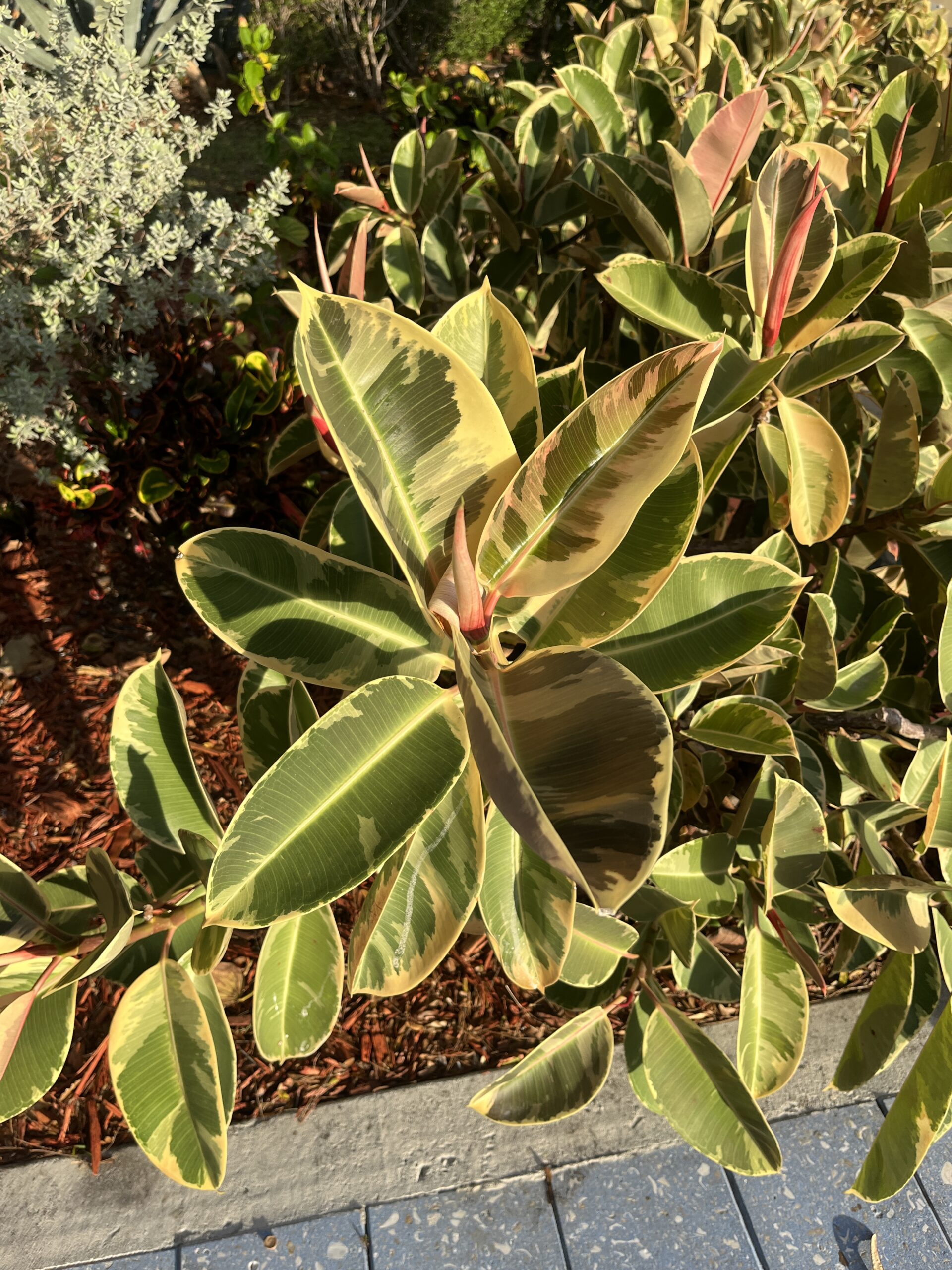
Habit: Ficus elastica grows as an evergreen large tree to 30 m in height and up to 3 m in diameter. It can occasionally produce aerial roots/prop roots. The glabrous leaves are arranged alternately, 15 – 30 cm in length, elliptic to ovate/oblong/obovate, with an entire margin, an extended acuminate/apiculate (drip tip) leaf apex. The leaves can be variegated with reds and whites.
Where the petiole attaches to the stem there is a prominent ring on the stem formed from the dehiscent apical sheath. The reddish apical sheath/stipules have a slight hook at the tip known as a “cats claw” and extends to up 10 cm. Vegetative material produces a milky latex when broken.
The highly reduced incomplete, imperfect, actinomorphic, flowers are borne entirely within a structure known as a synconium (fig) and are fertilized by wasps. It is monoecious. Staminate flowers have a perianth of 2-6 parts and 2 anthers. The carpellate flowers have no perianth or stamens and a single carpel. The yellow berry-like, elliptical “fruits” are subsessile on the stem at the base of the petioles often in pairs.
Habitat: Ficus elastica grows in the Bahamas in Human Altered environments (yards, gardens, inside homes).
Distribution: Ficus elastica is not native to the Lucayan Archipelago. It is native to the China, south central Asia and the eastern Indian subcontinent.
Medicinal/Cultural/Economic usage: Ficus elastica is not known to be used medicinally in the Bahamas.
Ficus elastica is used as an ornamental tree or shrub for its distinctive leaf variegation.