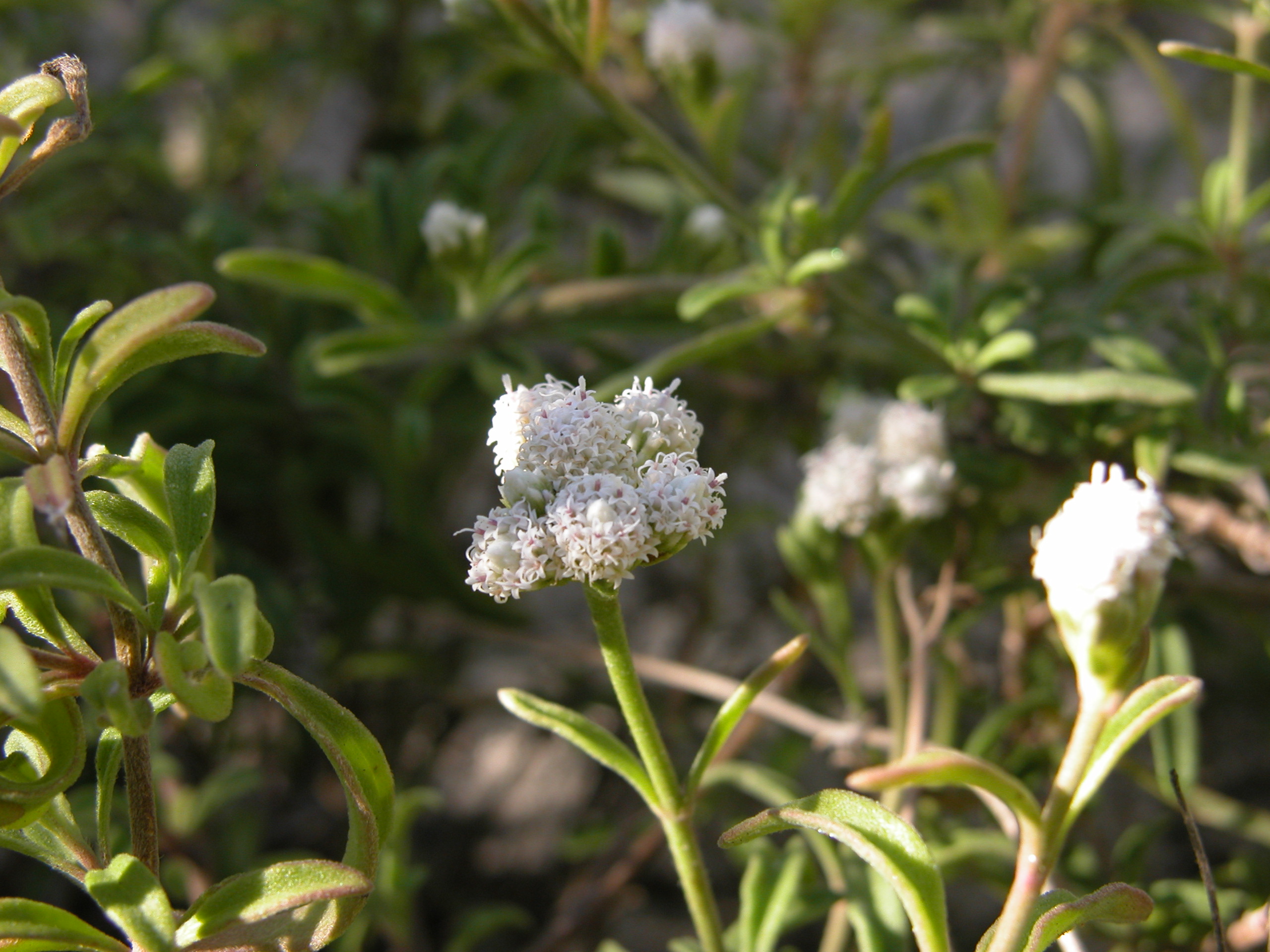
Habit: Isocarpha oppositifolia grows as a perennial herb/subshrub to 1 m in height (usually lower) when in flower. The leaves are arranged oppositely, to 9 cm in length (usually smaller), up to 2 cm wide, subsessile with narrowed lamina at base, lanceolate to oblanceolate to elliptic, with an acute to rounded leaf apex and an entire to slightly notched margin. The leaves and stems have a covering of pubescence both glandular and non-glandular.
The incomplete, perfect, actinomorphic ray flowers are arranged terminally in solitary to clusters of 2-6 heads. There are no ligulate flowers. The head is subtended by glandular pubescent lanceolate phyllaries forming an involucre in 2 -4 series. There is no calyx or pappus. The corolla has 5, fused into a tube, white pubescent petals. There are 5, white to purplish red stamens that are fused to the inside of the corolla tube. The inferior ovary has a single locule. The fruit is an angular, glabrous, achene with ridges along the edges. All parts of the flowers are pubescent both glandular and non-glandular.
Habitat: Isocarpha oppositifolia grows on limestone in open Dry Broadleaf Evergreen Formations (shrublands) and Human Altered environments (old fields, abandoned areas).
Distribution: Isocarpha oppositifolia is native to the Lucayan Archipelago occurring in the central island groups as well as the Greater Antilles, Texas, Mexico, Central and northern south America.
Medicinal/Cultural/Economic usage: Isocarpha oppositifolia is not known to be used medicinally in the Bahamas.