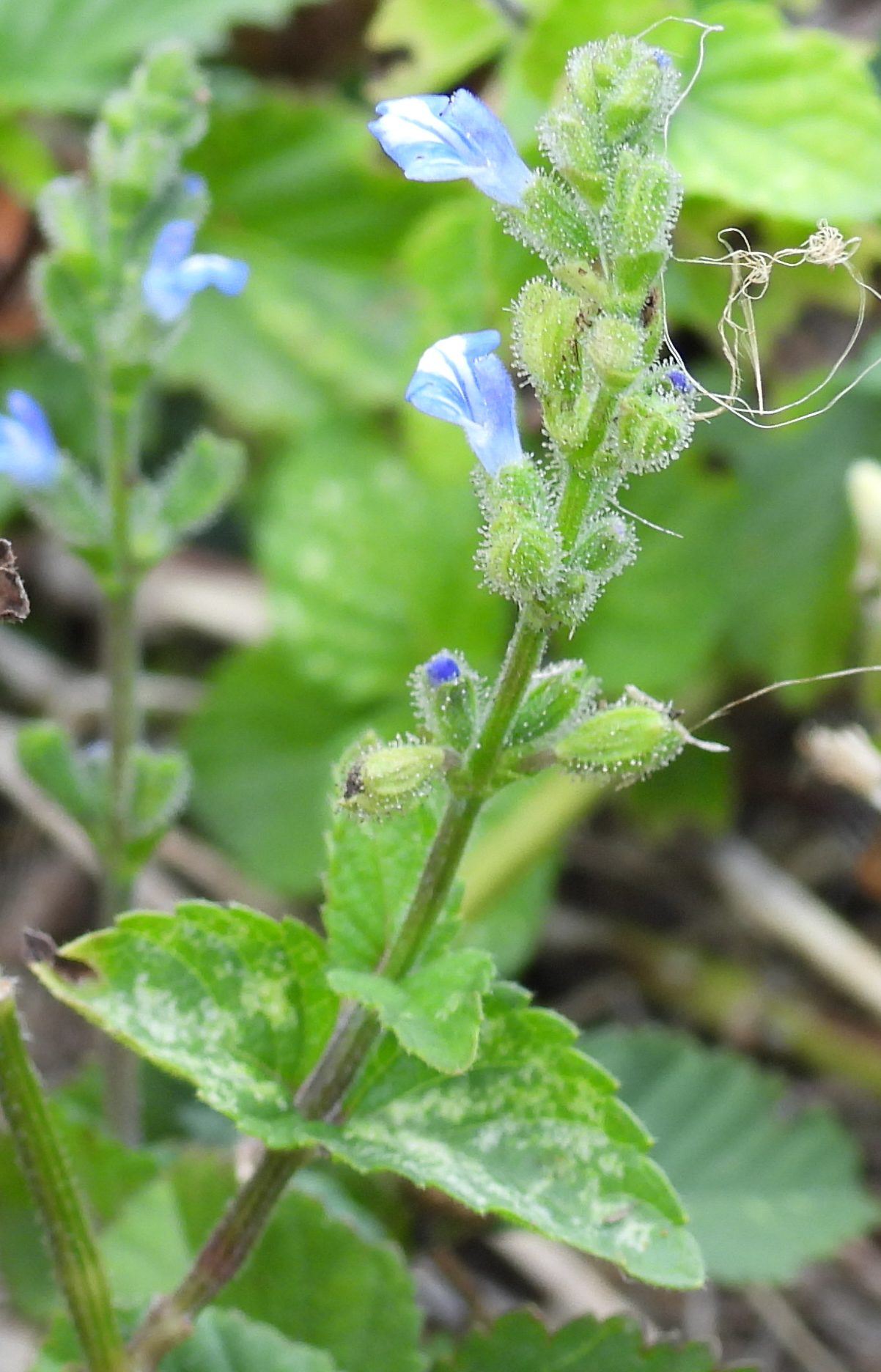
Habit: Salvia occidentalis grows as a prostrate to erect, annual to perennial up to 50 cm in height with slightly quadrangular stems. The leaves are arranged oppositely to 6 cm in length, ovate with a crenate leaf margin and an acute/acuminate leaf apex. All vegetative material is glandular pubescent.
The complete, perfect, zygomorphic flowers are arranged in racemes. The calyx has 5 fused, greenish sepals forming a tube that is covered with glandular pubescence. The corolla has 5, fused, light blue or white petals with 3 lobes below and 2 lobes above. There are 2 stamens. The ovary is superior with 4 locules each with a single seed. The fruit is an aggregate of nutlets.
Habitat: Salvia occidentalis grows in the Bahamas in Human Altered environments (yards, gardens, roadsides).
Distribution: Salvia occidentalis is native and occurs on all island groupings in the Lucayan Archipelago as well as Florida, the entire Caribbean region and Mexico south to Panama.
Medicinal/Cultural/Economic usage: Salvia occidentalis is not known to be used medicinally in the Bahamas.