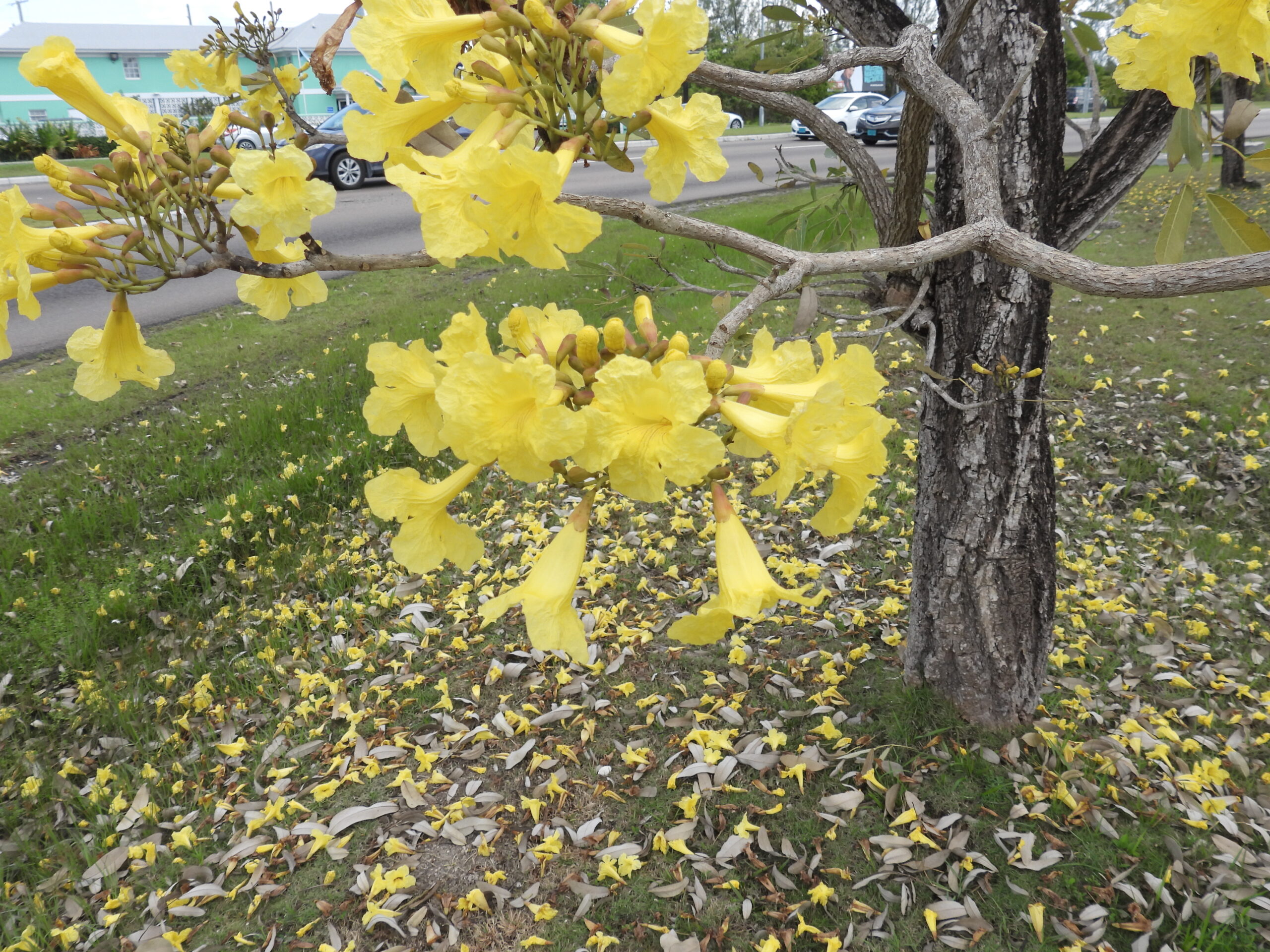
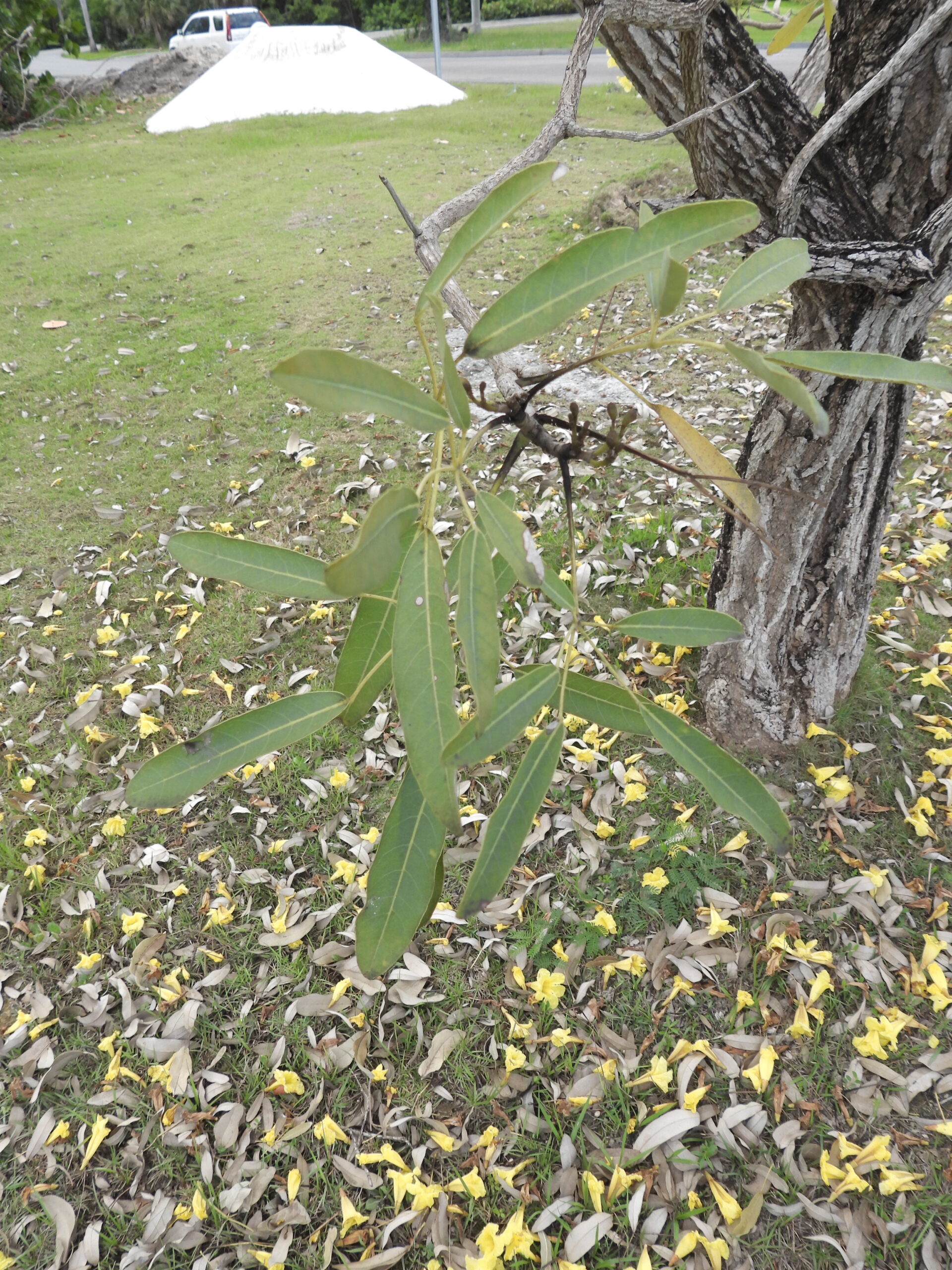
Habit: Tabebuia aurea grows as a large shrub to small tree up to 10 meters in height with a corky bark. The palmately compound leaves are arranged oppositely. There are 5-7 leaflets that are oblong to oblanceolate, each up to 20 cm, with a rounded or retuse leaf apex and an entire leaf margin. The central leaflet is petiolate, others sessile. The young stems and leaflets have silver-colored lepidote scales.
The complete, perfect, zygomorphic flowers are arranged solitarily or in clusters of 9-15. The calyx has 5 fused, greenish sepals. The corolla has 5 bright yellow, fused petals. There are 4 stamens fused to the corolla tube. The superior ovary has 2 locules and forms a capsule at maturity. The seeds are winged.
Habitat: Tabebuia aurea occurs in the Bahamas in Human Altered environments in the Bahamas (yards, gardens, roadsides).
Distribution: Tabebuia aurea is not native to the Lucayan Archipelago. It is native to the South America.
Medicinal/Cultural/Economic usage: Tabebuia aurea has is not known to be used medicinally in the Bahamas.
It is grown as an ornamental and planted as a street tree.