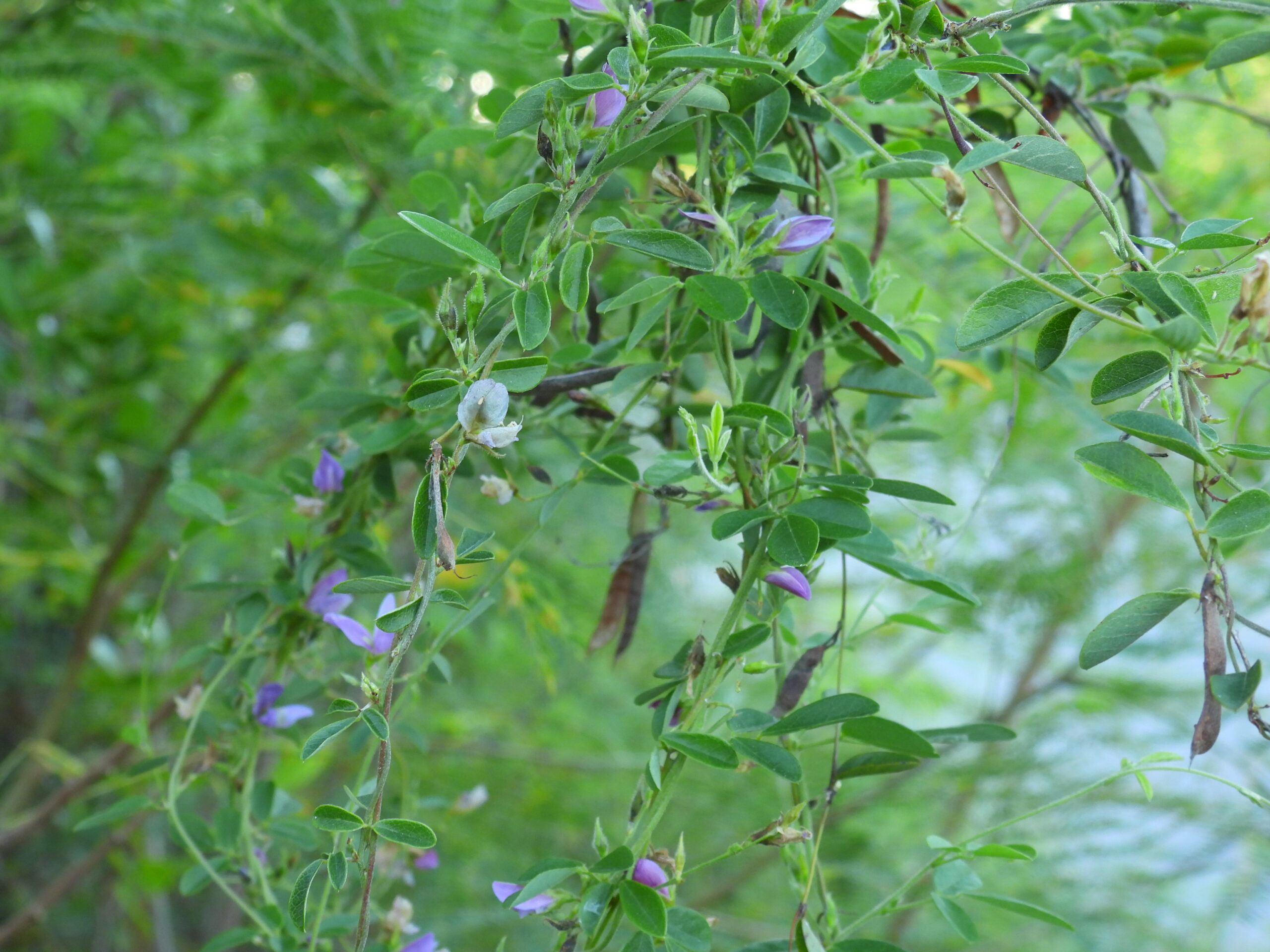
Habit Teramnus uncinatus grows as a pubescent, perennial vine with angled stems, growing on shrubs and small trees. The trifoliate compound leaves are arranged alternately with small linear stipules at the petiole base. The 3 leaflets are up to 8 cm in length, linear/lanceolate/ovate with a mucronate leaf apex with an entire margin and is densely pubescent abaxially.
The complete, perfect, zygomorphic flowers are arranged in axillary racemes that are longer than the leaves. The calyx has 5, partially fused, pubescent green sepals forming a tube with the sepal lobes the same length as the tube. The corolla has 5 purple/pink sepals with the upper enlarged to form the banner and the lower 2 fused to form the keel. There are 5 stamens and 5 staminodes. The ovary is superior and has a single locule with numerous seeds. The fruit is a pubescent brown legume up to 5 cm in length at maturity with a beak at a right angle.
Habitat: Teramnus uncinatus grows in the Lucayan Archipelago in Human Altered environments (old fields, yards roadsides) and at the edges of Dry Broadleaf Evergreen Formations – Forest/Shrublands.
Distribution: Teramnus uncinatus occurs throughout the Lucayan Archipelago but is not common. It is native to Mexico, Central and northern South America as well as central Africa and Madagascar.
Medicinal/Cultural/Economic usage: Teramnus uncinatus is not known to be used medicinally in the Bahamas.