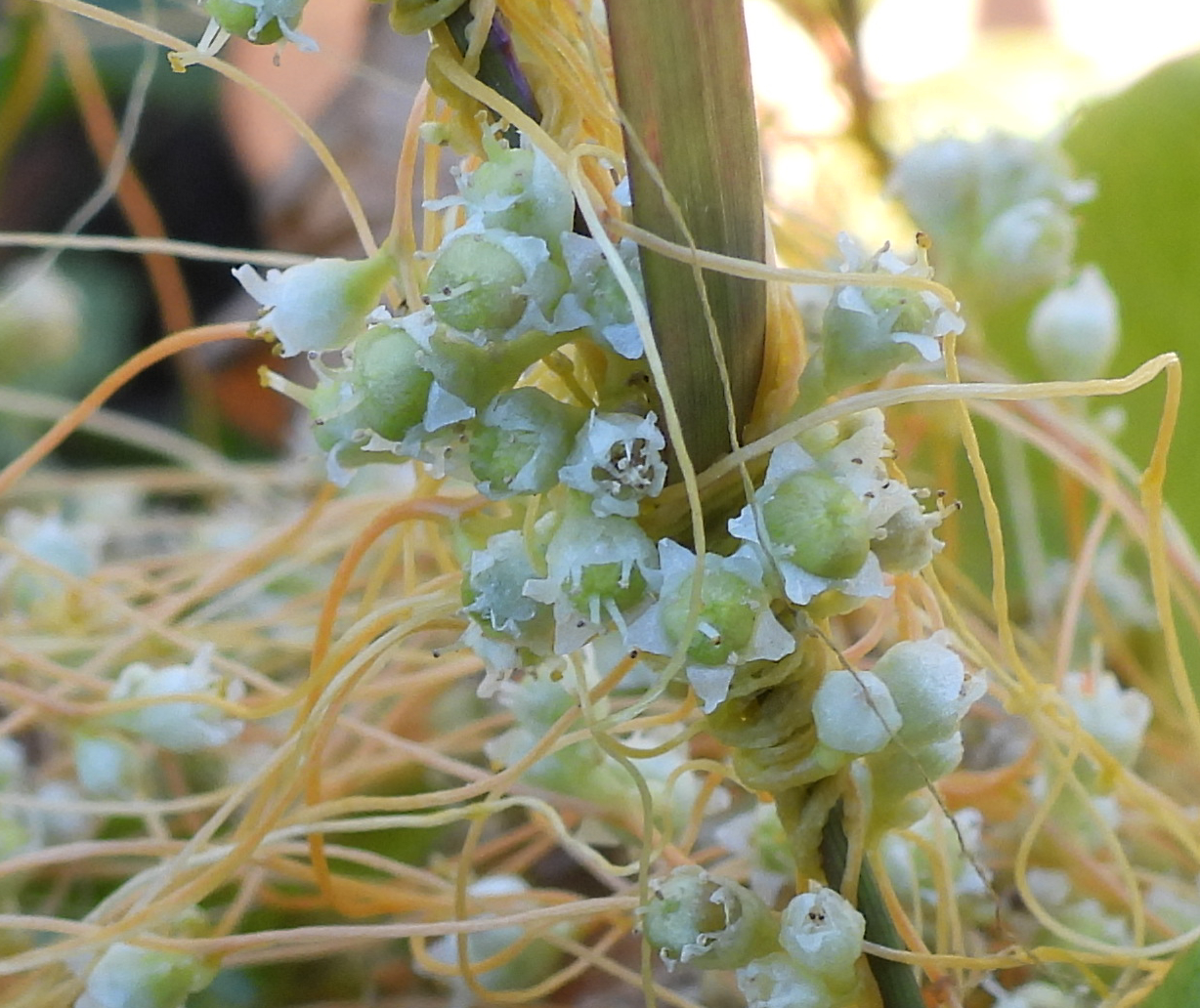

Habit Cuscuta campestris grows as a yellowish orange parasitic vine to 7 meters in height covering other vegetation and attached via haustoria to branches and leaves. There are highly reduced scale like leaves.
The complete, perfect, actinomorphic, flowers are arranged in tight clusters. The calyx has 5 greenish white, fused, sepals. The corolla has 5 whitish yellow, fused petals with reflexed and spreading lobes that are acute/triangular. On the interior of the corolla between the stamens are fringed scales. The calyx and the corolla are about the same length. There are 5 stamens subsessile on the corolla. The ovary is superior with 2 locules and multiple ovules. The fruit is a capsule at maturity.
Habitat: Cuscuta campestris grows on plants in Sabal palmetto Woodlands, and other types of ephemeral Fresh Water areas.
Distribution: Cuscuta campestris occurs primarily on the northern island groupings within the Lucayan Archipelago as well as the Caribbean, Mexico, North, Central and northern South America. It has become naturalized throughout much of the world.
Medicinal/Cultural/Economic usage: Cuscuta campestris is used not known to be medicinally in the Bahamas.
It can be an agricultural problem infecting crop plants.