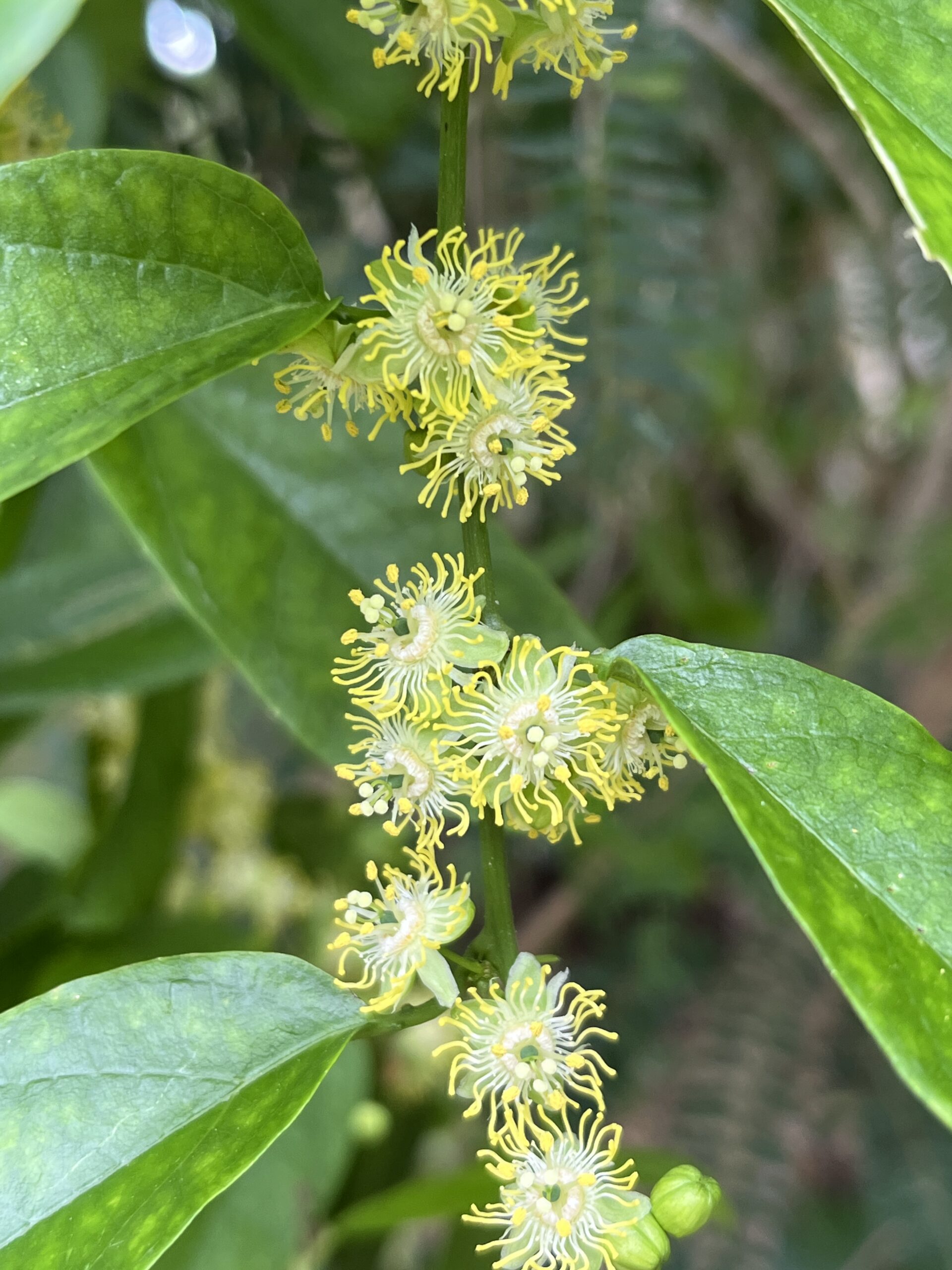
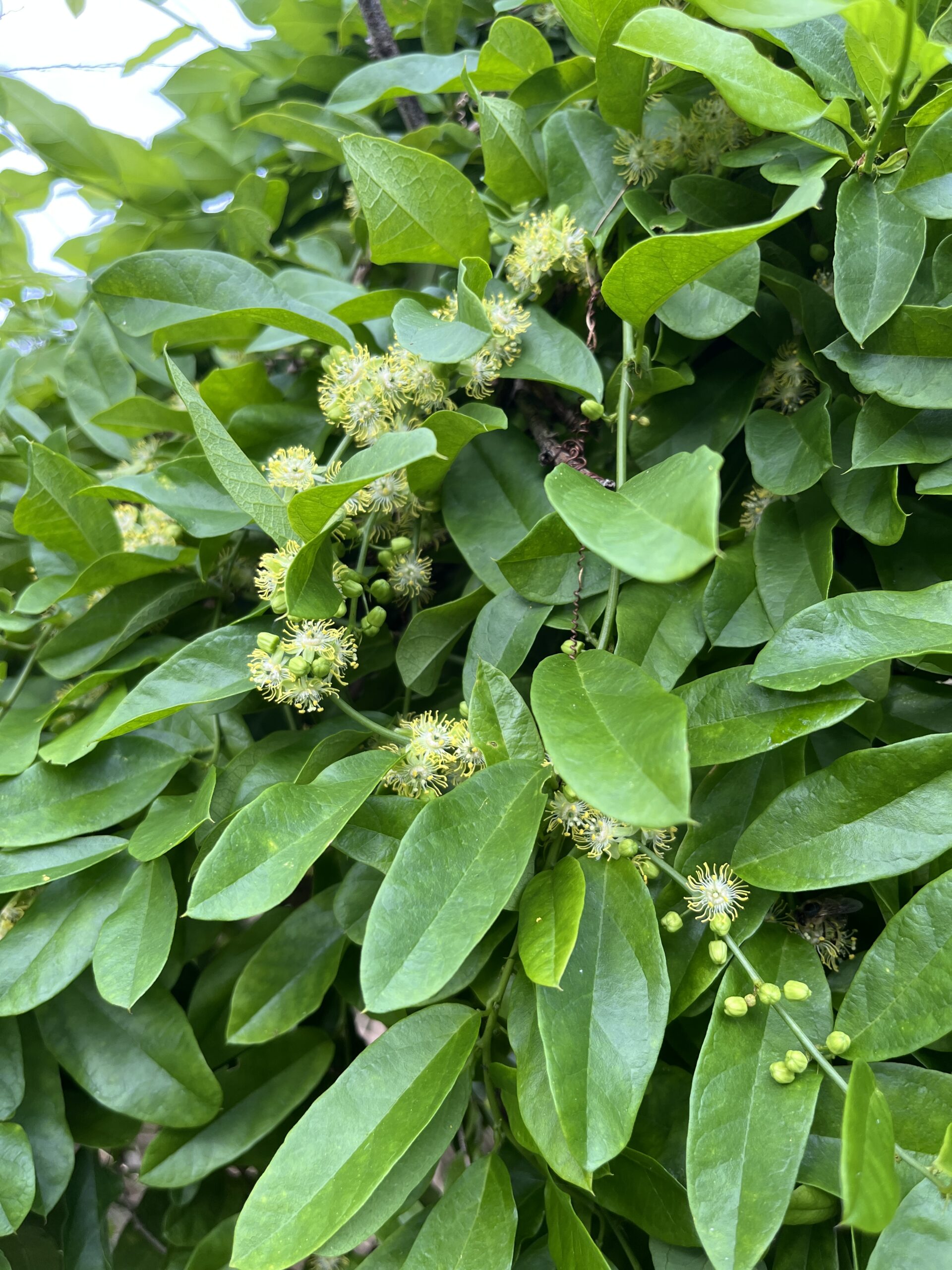
Habit: Passiflora multiflora grows as vine with older portions of the stem becoming slightly corky at the base with age. Vegetation has slight pubescence. The oblong to oblanceolate leaves are arranged alternately, to 10 cm in length, unlobed with an entire/undulating margin and a rounded or mucronate apex. At the top of the petiole are 2 round glands. Tendrils are present at the nodes.
The complete, perfect, actinomorphic flowers are arranged are in groups of 3-6, in leaf axils. There is a linear bract below the flower. The calyx has 5 green unfused sepals. There is no corolla. There is a corona with white and yellow filaments in 2 series. The outer filiform and the inner reduced to nubs. There are 5 stamens. The ovary is superior, with 3 stigmatic lobes, a single locule and numerous seeds. The fruit is a berry that turns dark blue/black at maturity.
Habitat: Passiflora multiflora grows in Dry Broadleaf Evergreen Formations – Forests/Shrublands.
Distribution: Passiflora multiflora occurs on the northern islands in the Lucayan Archipelago as well as the Caribbean region, Florida and Central America.
Medicinal/Cultural/Economic usage: Passiflora multiflora is not used medicinally in the Lucayan Archipelago.