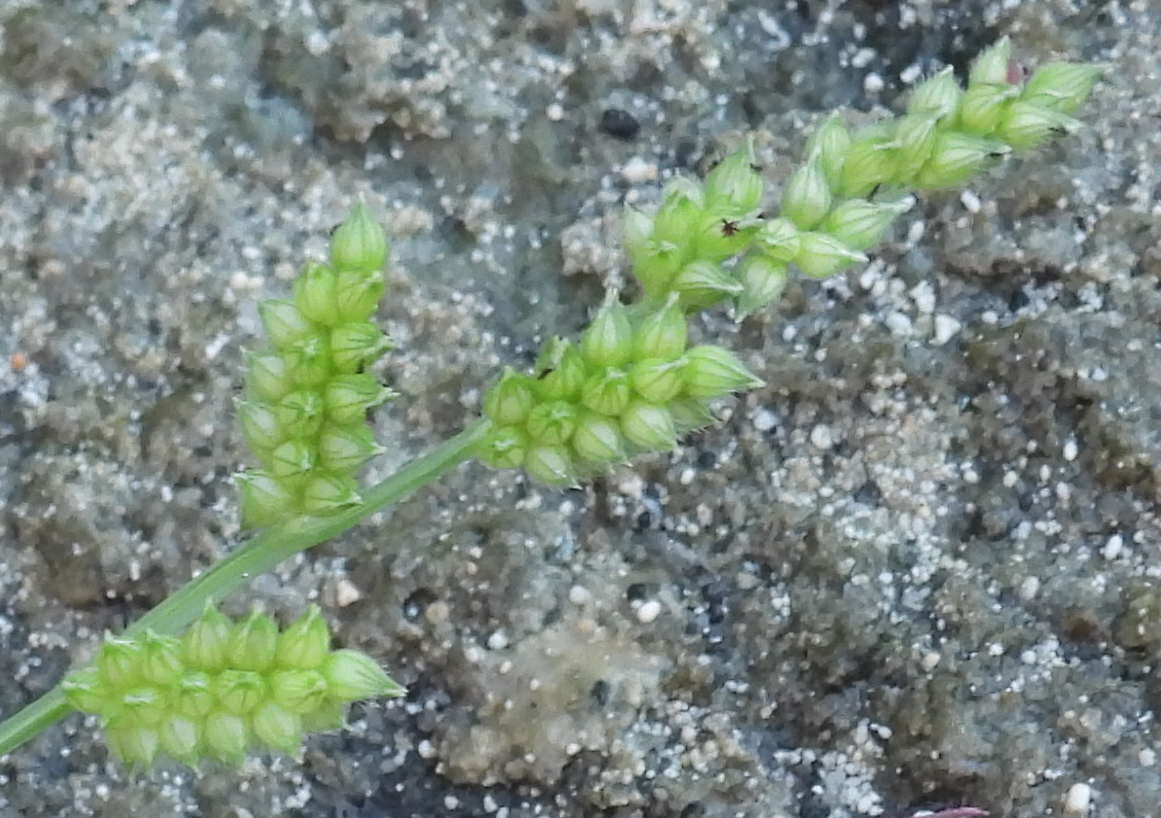

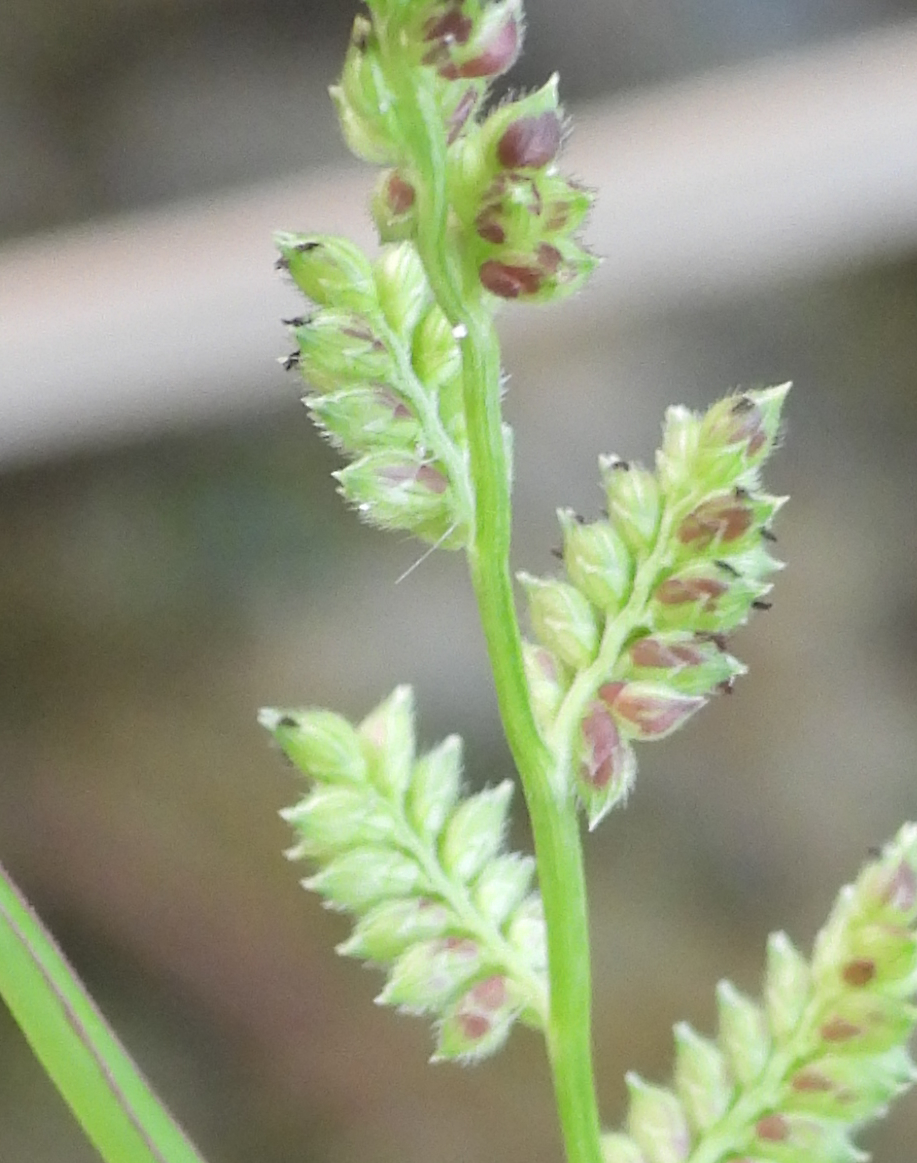
Habit: Echinochloa colona grows as an annual to 60 cm in height when flowering, usually lax and sprawling. The leaves are arranged alternately to 15 cm in length (usually shorter) and 5 mm wide with a basal sheath extending along the stem. There is no ligule. The leaves are parallel veined, scabrous margined, keeled.
The zygomorphic flowers are arranged in a terminal panicle made of congested racemes of spikelets. At the base of each spikelet are 2 structures called glumes. The first glume small and the second larger and pubescent. In each ovate spikelet there are flowering structures each is subtended by 2 additional structures (lemma and palea) and are pubescent. There are 3-5 florets with 3 stamens and a superior ovary each with a single locule and seed. The fruit is a caryopsis.
Habitat: Echinochloa colona grows in Human Altered environments (waste areas, abandoned fields, old farms) especially those that are wet at least part of the year.
Distribution: Echinochloa colona is NOT native to the Lucayan Archipelago but is found throughout the islands. It is native to Africa, Asia, and Europe but is now widespread globally as a noxious weed.
Medicinal/Cultural/Economic usage: Echinochloa colona is not known to be used medicinally in the Lucayan Archipelago.
The seeds can be eaten.