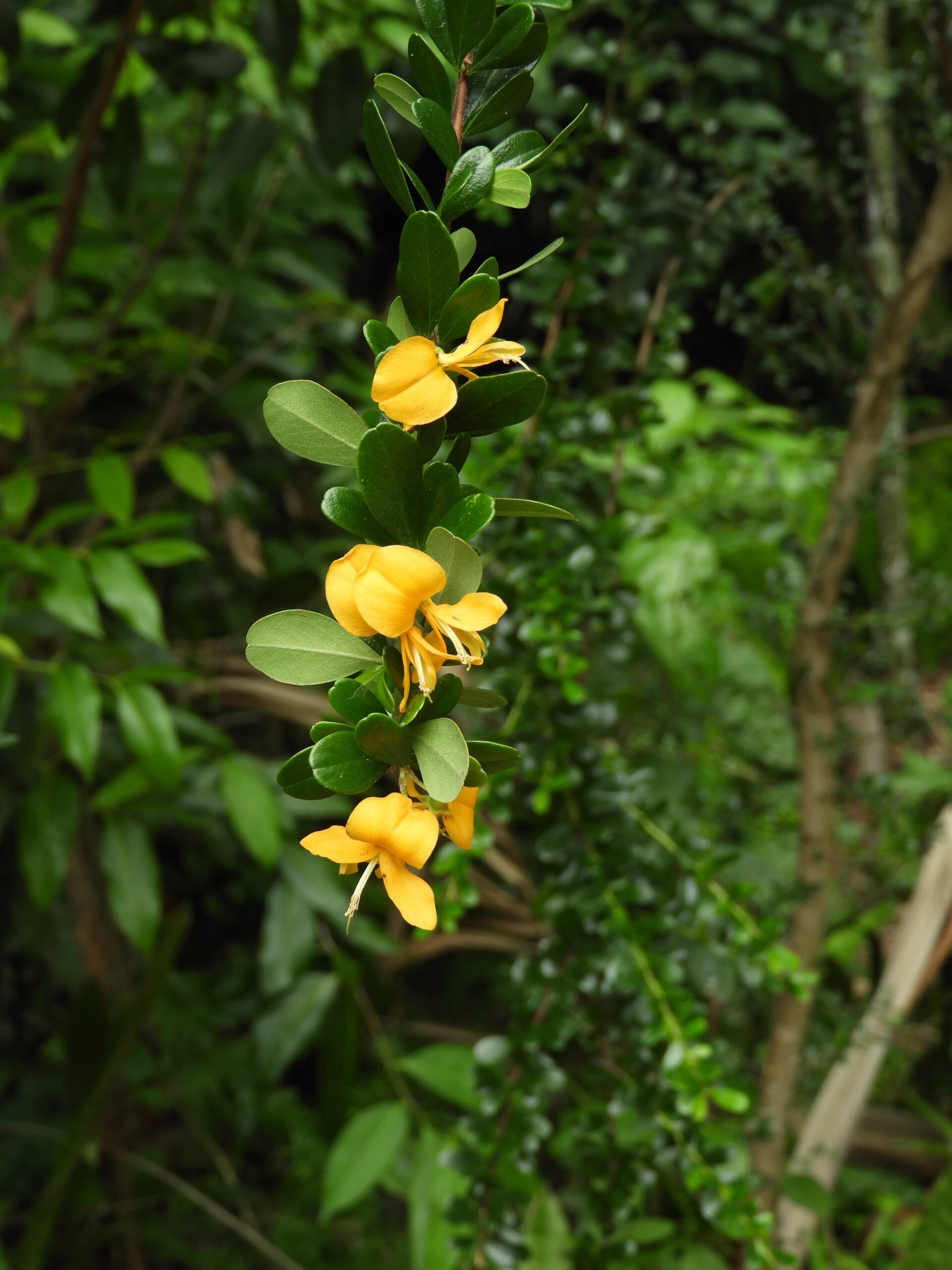
Habit: Brya ebenus grows as a winter deciduous tree up to 8 m in height. The bipinnately compound leaves are arranged alternately. The petioles have a slightly swollen pulvinus. The leaflets are in 1-2 dense pairs on reduced branches with leaflets appearing as simple leaves. Each leaflet to 3 cm in length, elliptic to oval, with a round to acute leaf apex, with an entire margin.
The complete, perfect, zygomorphic flowers are arranged in axillary racemes. The calyx has 5 greenish, unfused, oblong sepals. The corolla has 5 yellow, unfused petals, the lower two forming a keel, the upper a banner and the 2 lateral petals as wings. There are 10 stamens (9+1 arrangement). The ovary is superior and forms an elongate, pendulous, many-seeded dark brown legume at maturity up to 60 cm in length and 3 cm in width.
Habitat: Brya ebenus grows in Human Altered environments (yards and gardens).
Distribution: Brya ebenus is NOT native to the Lucayan Archipelago. It is native to Cuba.
Medicinal/Cultural/Economic usage: Brya ebenus is not known to be used medicinally in the Lucayan Archipelago.
It is grown as an ornamental for its showy flowers.
The wood is very dense and has good acoustic properties and has been used to make wooden musical instruments.