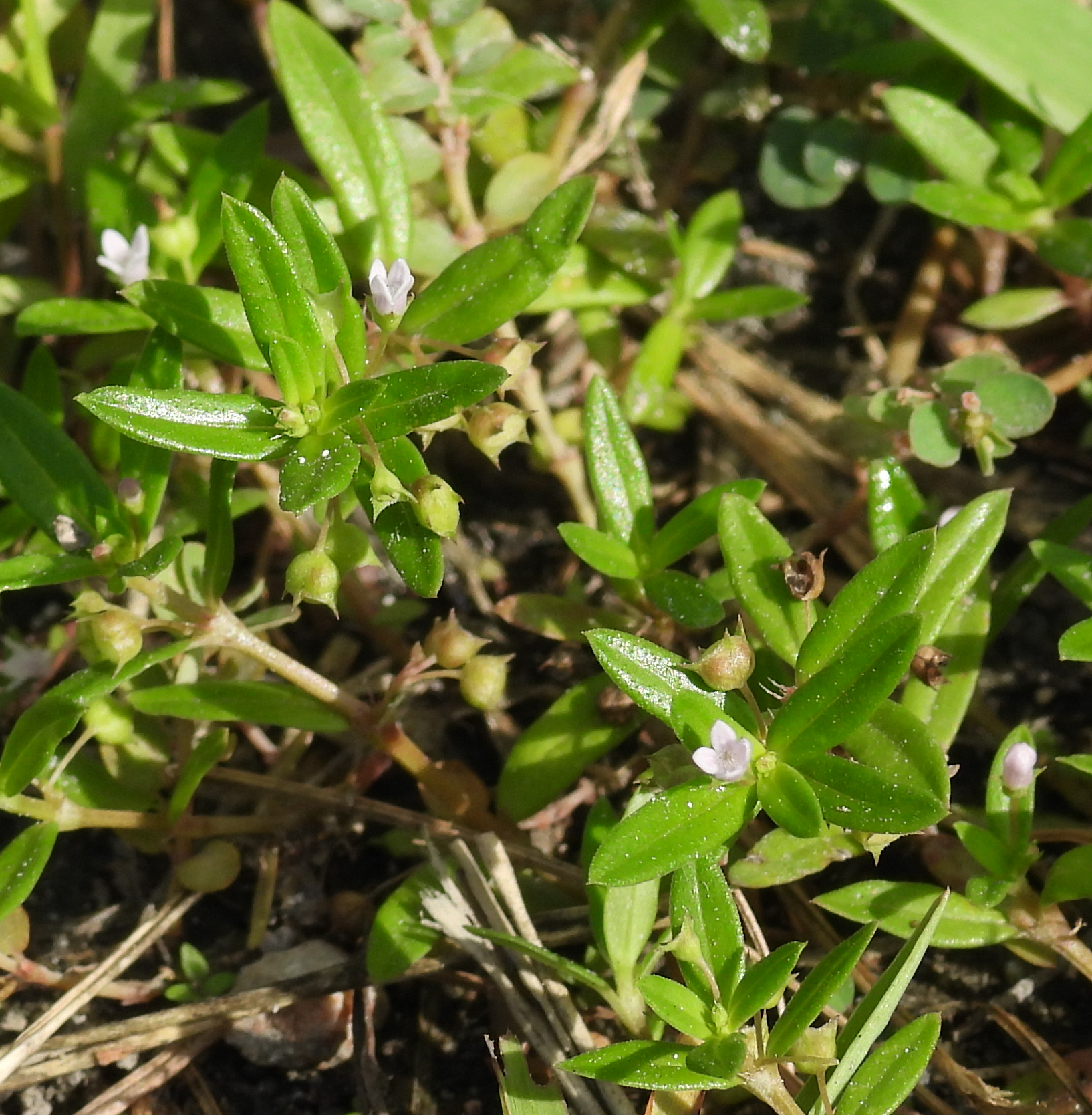
Habit: Oldenlandia corymbosa grows as an erect to creeping, glabrous perennial up to 50 cm in height and outwards to 5o cm. The stems are quadrangular with ridges at the angles. The leaves are arranged oppositely, linear to lanceolate, up to 3 cm in length, with an acute/mucronate/apiculate leaf apex and an entire leaf margin. The adaxial and leaf margin surfaces are rough/scabrid. There is a stipular sheath.
The complete, perfect, actinomorphic flowers are solitary or in few flowered corymbs in leaf axils. The calyx has 4, fused at their base, slightly pubescent, sepals. The corolla has 4, fused at their base white petals that form a short tube with a pubescent throat. There are 4 stamens that are fused to the corolla. The ovary is inferior with 2 locules with many ovules. There are flowers with long styles and short styles (heterostylous). The fruit has 4 pointed projections/beaks along the edge of the flat-topped capsule.
Habitat: Oldenlandia corymbosa grows in the Bahamas in Human Altered environments (yards, gardens, lawns).
Distribution: Oldenlandia corymbosa is not native to the Lucayan Archipelago. It is native to central South America, central Africa, the Indian subcontinent and south east Asia. It has spread to all other tropical and subtropical areas of the globe as an invasive plant.
Medicinal/Cultural/Economic usage: Oldenlandia corymbosa is not known to be used medicinally in the Bahamas.
It has been used medicinally in India and China.