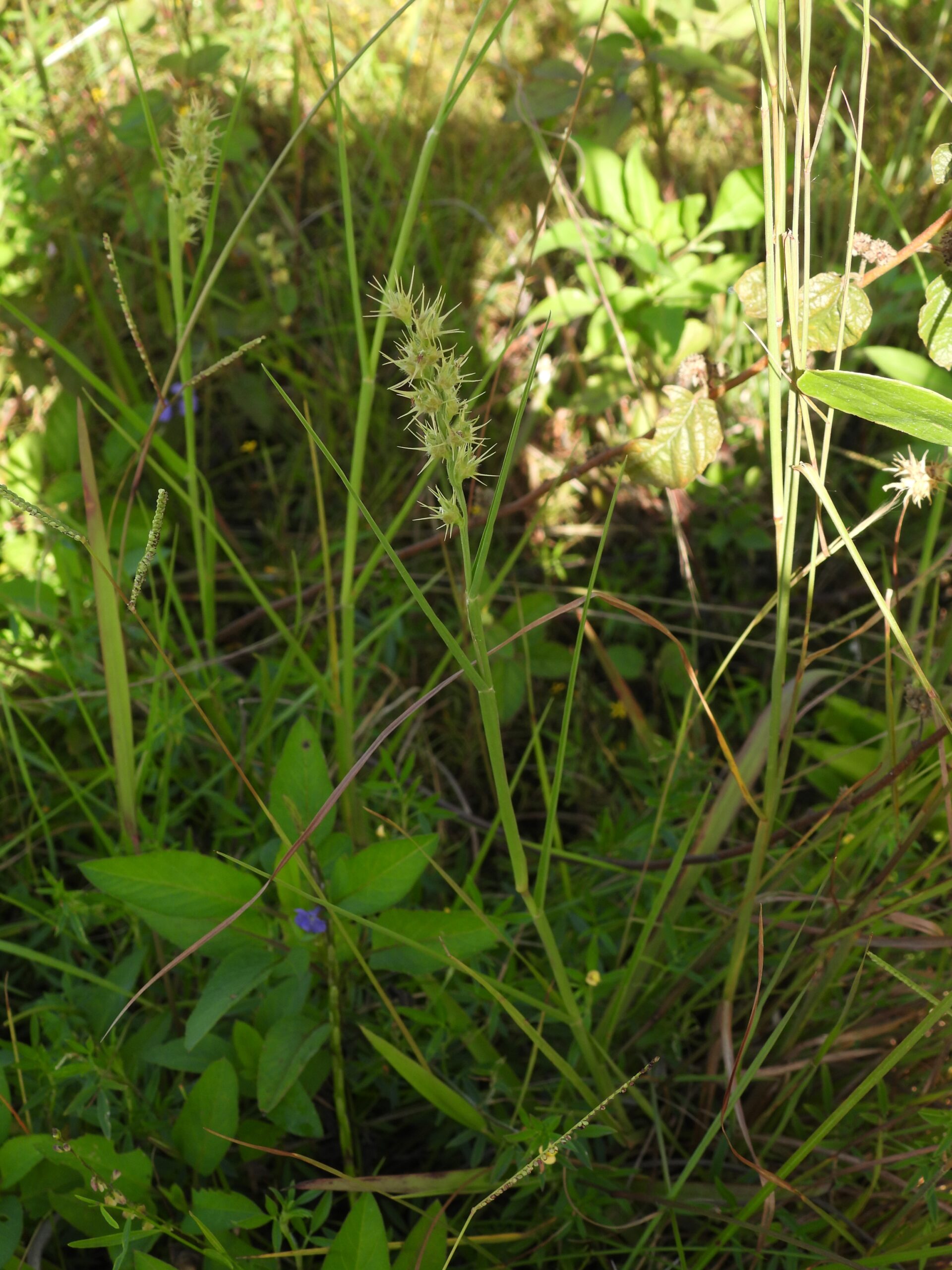
Habit: Cenchrus tribuloides grows as a decumbent annual to 50 centimeters in length. The leaves are arranged alternately with a sheath extending along the stem that is pubescent along its edge. At the point of divergence of the leaf sheath to the leaf blade is a ciliate ligule. The leaves are parallel veined and to 15 centimeters in length and up to 1 cm wide at the point of divergence.
The imperfect, incomplete, zygomorphic flowers are arranged in a terminal racemose panicle. The flowers are highly modified without identifiable structures such as the calyx or corolla. Each flowering unit is a spikelet at the base of which are 2 yellow brown structures called glumes. In the spikelet, there are 2 flowering structures each is subtended by 2 additional structures (lemma and palea).
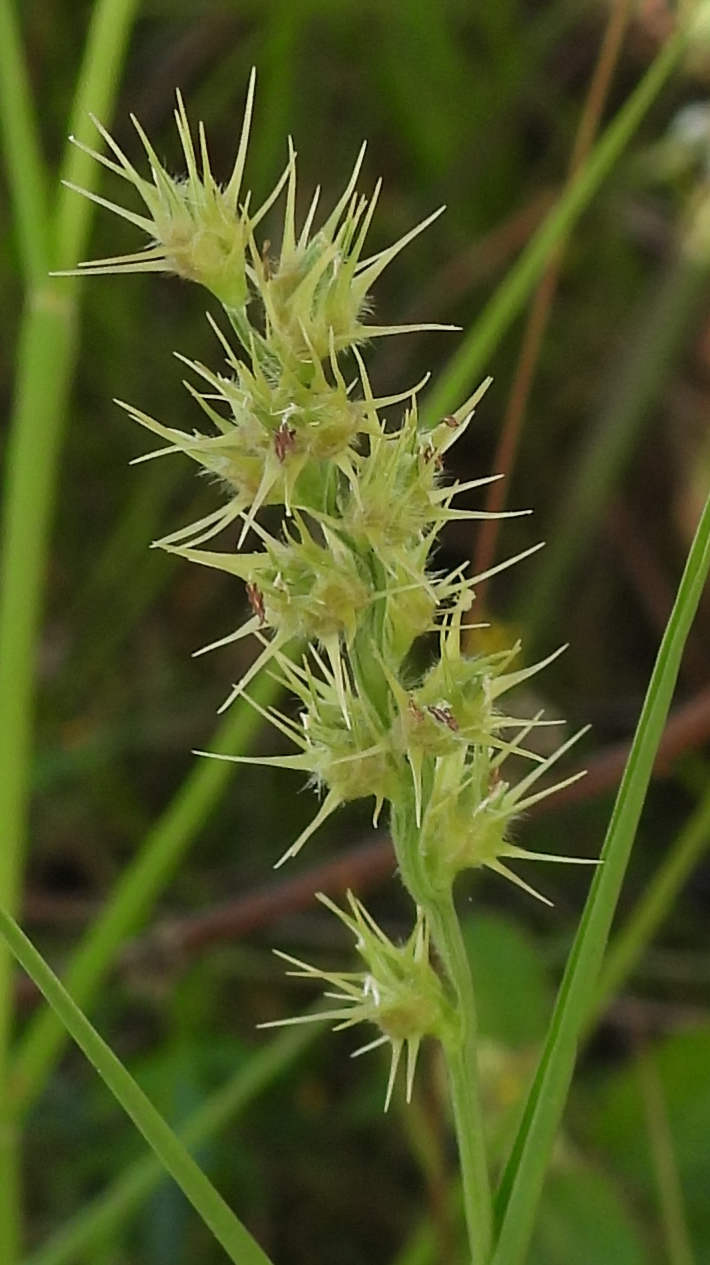
The entire spikelet surrounded by bracts that are sharpened into spines forming a burr. The spines are connate more than half their length. The space between the spines is densely pubescent. In each flower within the spikelet there are 3 stamens. The fruit is a caryopsis that turns black at maturity. The entire spikelet/burr is the dispersal unit.
Cenchrus tribuloides differs from C. incertus in the presence of pubescence between the spines on the burr and narrower leaf blade.
Habitat: Cenchrus tribuloides grows in sandy areas near coastal areas (Dunes) as well as Human Altered environments (lawns, abandoned fields, disturbed areas, roadsides).
Distribution: Cenchrus tribuloides is native to the Lucayan Archipelago as well as the Eastern and southern United States, the Caribbean region and northern South America.
Medicinal/Cultural/Economic usage: Cenchrus tribuloides has not been used medicinally in the Bahamas.