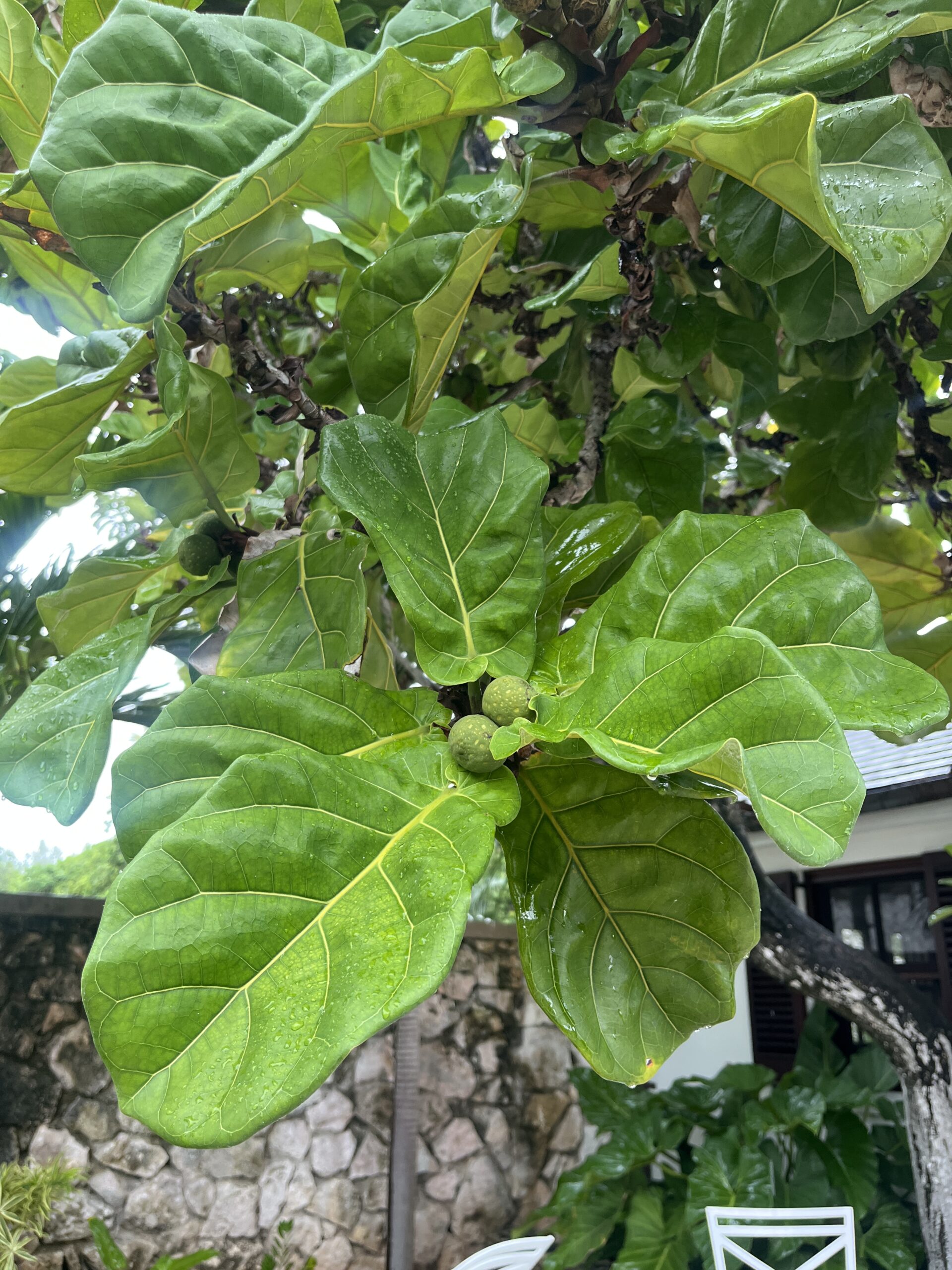
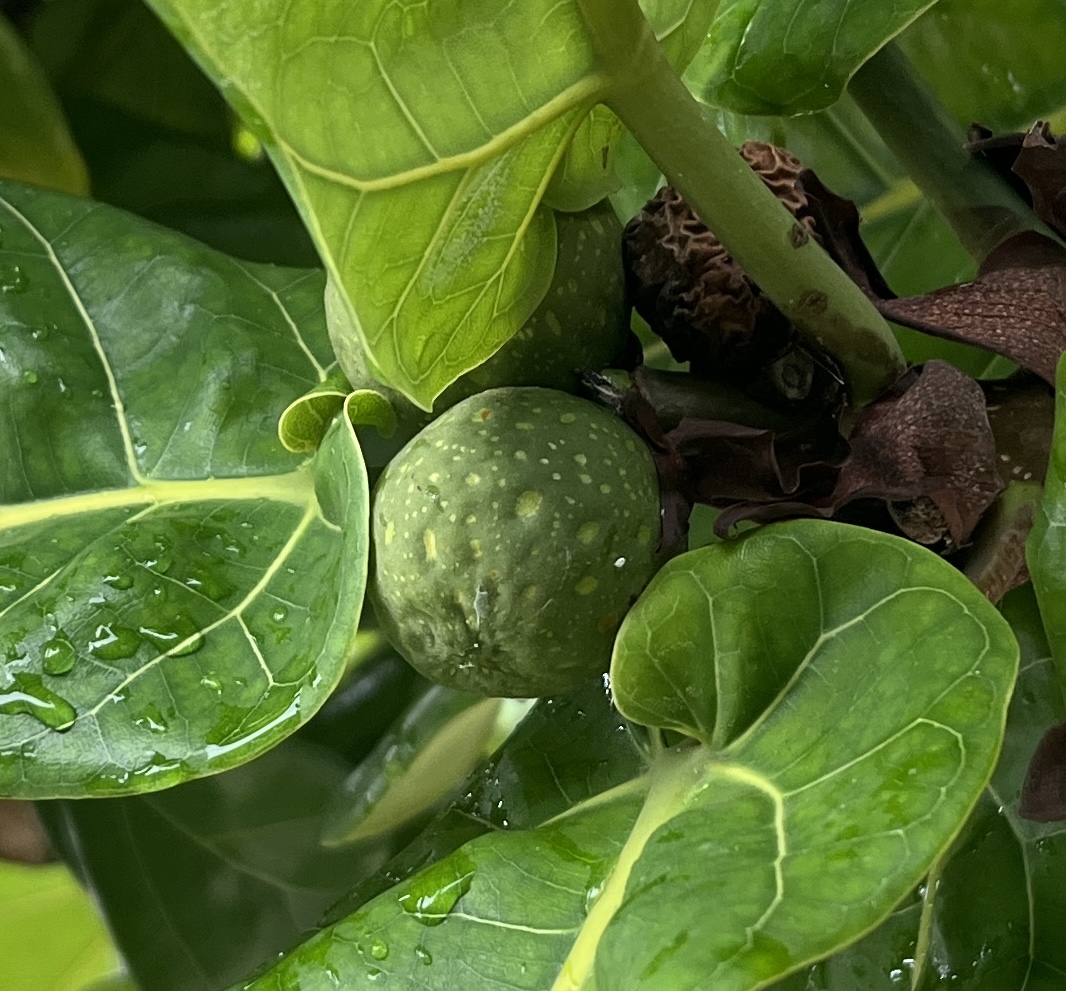
Habit: Ficus lyrata grows as a large tree to 15 meters in height, a trunk to 50 cm in diameter. The leaves are arranged alternately to 40 cm in length, violin or fiddle shaped, with an entire undulate margin, a rounded to slightly acute leaf apex and a cordate/hastate leaf base. The petioles are grooved.
Where the petiole attaches to the stem there is a prominent ring on the stem formed from the dehiscent apical sheath. The apical sheath has a slight hook at its tip known as a “cats claw”. Vegetative material produces a slightly milky latex when broken.
The highly reduced incomplete, imperfect, actinomorphic, flowers are borne entirely within a structure known as a Synconium (fig) and are fertilized by wasps. It is monoecious. Staminate flowers have a perianth of 2-6 parts and 2 anthers. The carpellate flowers have no perianth or stamens and a single carpel. The red berry-like “fruit” is sessile.
Habitat: Ficus lyrata grows in Human Altered environments (yards, gardens, inside homes).
Distribution in Bahamas/Globally: Ficus lyrata is not native to the Lucayan Archipelago. It is native to central and western tropical Africa. It is grown globally as an ornamental
Medicinal/Cultural/Economic usage: Ficus lyrata is not known to be used medicinally in the Lucayan Archipelago.
Ficus lyrata is used as an ornamental tree and as a house plant.