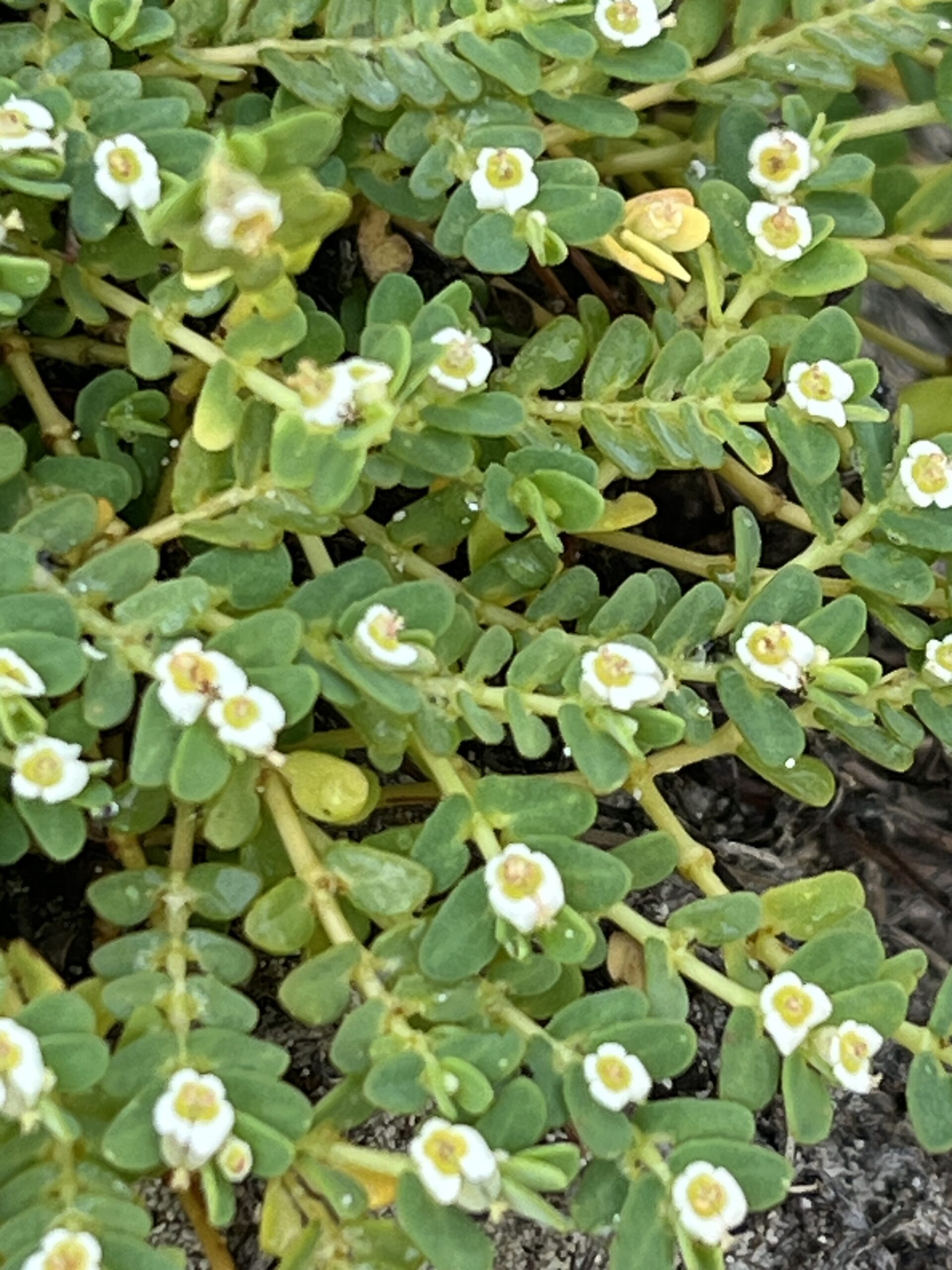
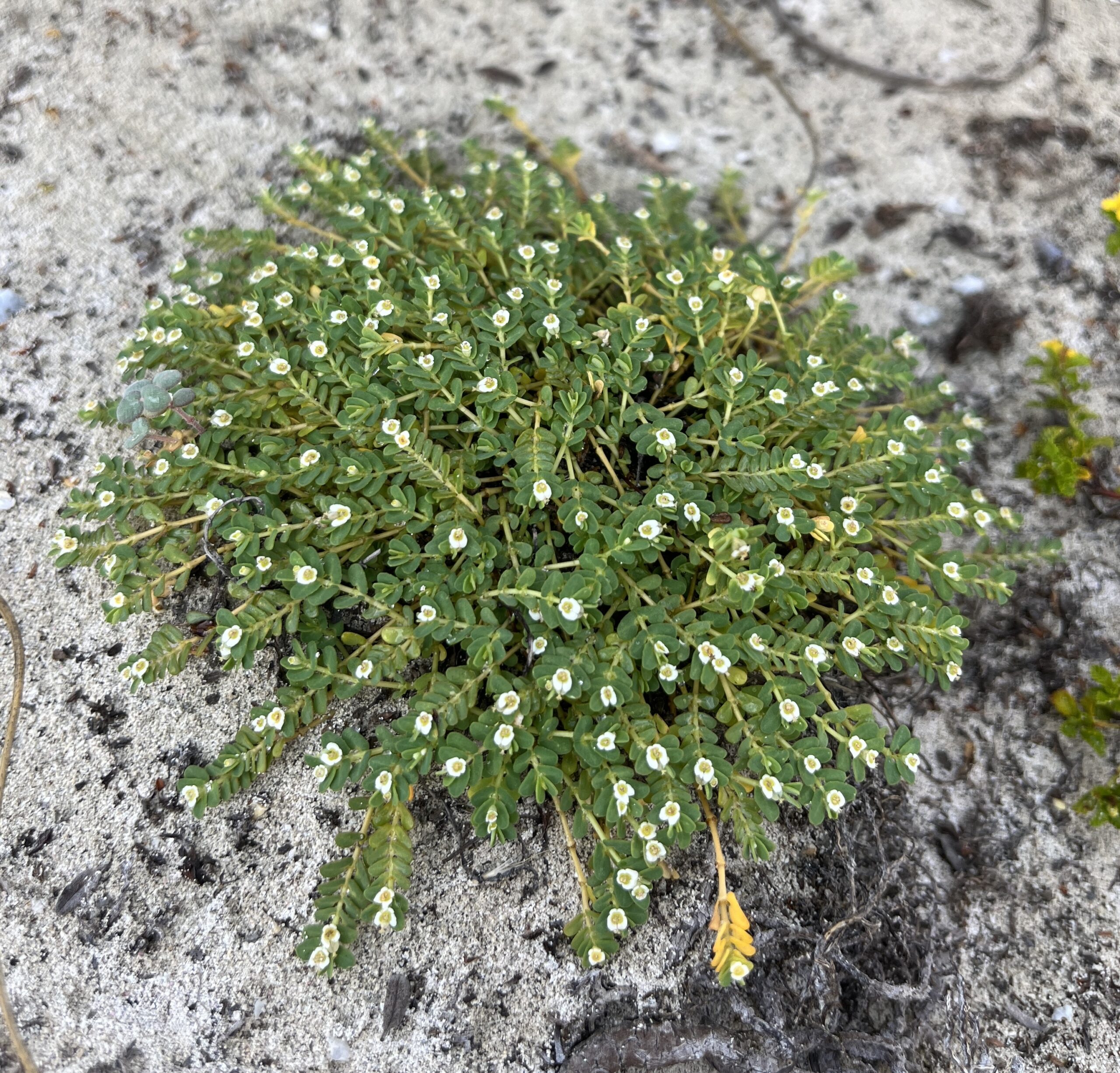
Habit: Euphorbia centunculoides grows as erect/ascending semi-succulent, glabrous perennial to 15 cm in height (typically shorter) forming mounds. The leaves are arranged oppositely, ovate to suborbicular, to 5 mm in length with an acute to round leaf apex and entire leaf margin. At the base of the petiole are 2 round to lanceolate, entire to divided, stipules. The vegetation produces a thick, milky sap.
The incomplete, imperfect, monoecious, actinomorphic, flowers are arranged in tight clusters of glabrous cyathia that have green/brown/red glands along the edges and occur in the axils of leaves. The lip of the cyathia is white. There is no calyx or corolla. Staminate flowers are reduced to a single stamen. Carpellate flowers are reduced to a single superior carpel, each with 3 locules and numerous seeds. The fruit is a capsule at maturity that splits along 3 suture lines.
Habitat: Euphorbia centunculoides grows behind Dunes in sandy coastal areas.
Distribution: Euphorbia centunculoides occurs on the Cay Sal bank in the Lucayan Archipelago and on islands and off shore cays along the northeastern coast of Cuba.
Medicinal/Cultural/Economic usage: Euphorbia centunculoides is not used medicinally in the Bahamas.
Euphorbia centunculoides is a Globally Endangered species as Red listed by the IUCN due to its narrow habitat size behind dunes, low population numbers, and small distribution area.
Oviedo, R., Becquer, E. & Freid, E.H. 2020. Euphorbia centunculoides. The IUCN Red List of Threatened Species 2020: e.T158457619A158499776.
https://dx.doi.org/10.2305/IUCN.UK.2020-3.RLTS.T158457619A158499776.en
All parts of the species are extremely toxic and should not be ingested!!