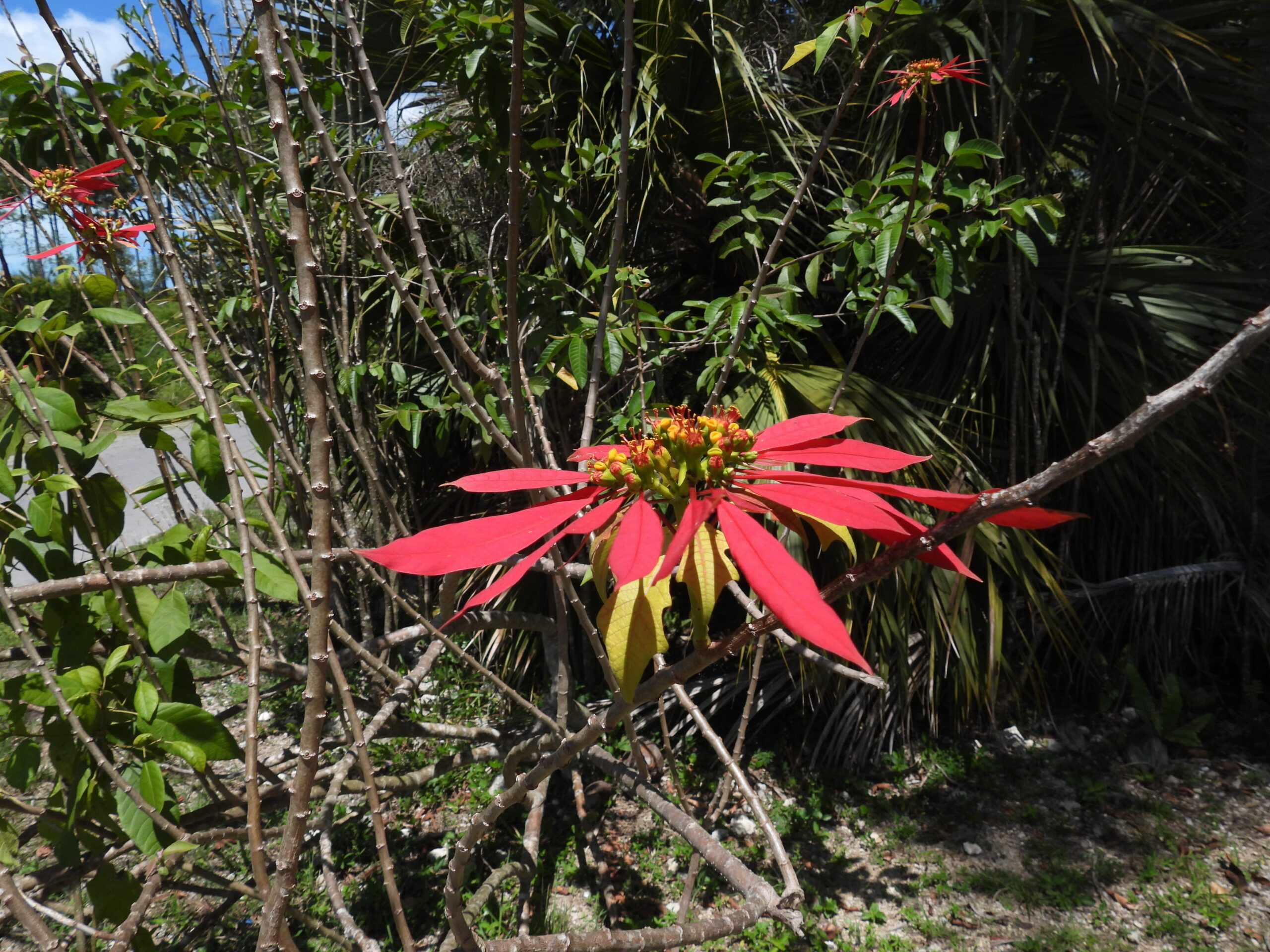
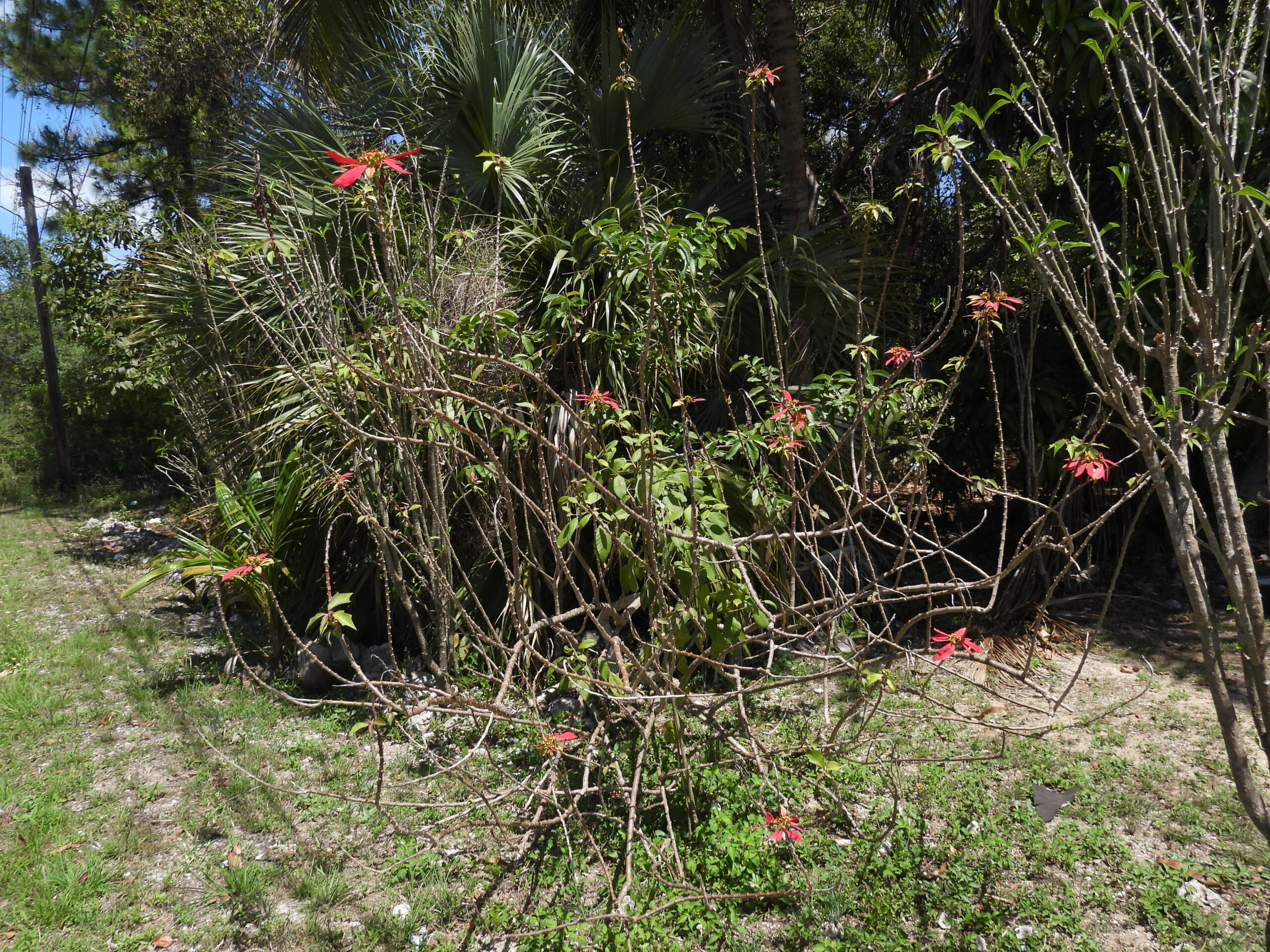
Habit: Euphorbia pulcherrima grows as a slightly pubescent, many branched, shrub up to 3 m in height (usually shorter). The leaves are arranged oppositely, up to 18 cm in length, ovate, with an entire or toothed to lobed leaf margin and an acute leaf apex. At the base of the petiole are short lived stipules. The vegetation is can be red.
The incomplete, imperfect, monoecious, actinomorphic, are arranged in glabrous cyathia clustered at branch/stem tips. There is 1 yellow-green-red, elongate, cup shaped, gland on the edge of the cyathia. The groups of cyathia are subtended by red showy, elliptic bracts to 20 cm in length.
There is no calyx or corolla. Staminate flowers are reduced to a single stamen. Carpellate flowers are reduced to a single superior carpel, each with 3 locules and numerous seeds. The glabrous fruit is a ridged capsule at maturity that splits along 3 suture lines.
Habitat: Euphorbia pulcherrima grows in Human Altered environments (yards and gardens).
Distribution: Euphorbia pulcherrima is NOT NATIVE to the Lucayan Archipelago. It is native to Mexico and Central America.
Medicinal/Cultural/Economic usage: Euphorbia pulcherrima is not known to be used medicinally in the Bahamas.
All parts of the species are extremely toxic and should not be ingested!!
It has been used in the floral and horticultural trade for its showy red floral bracts predominately at Christmas time.