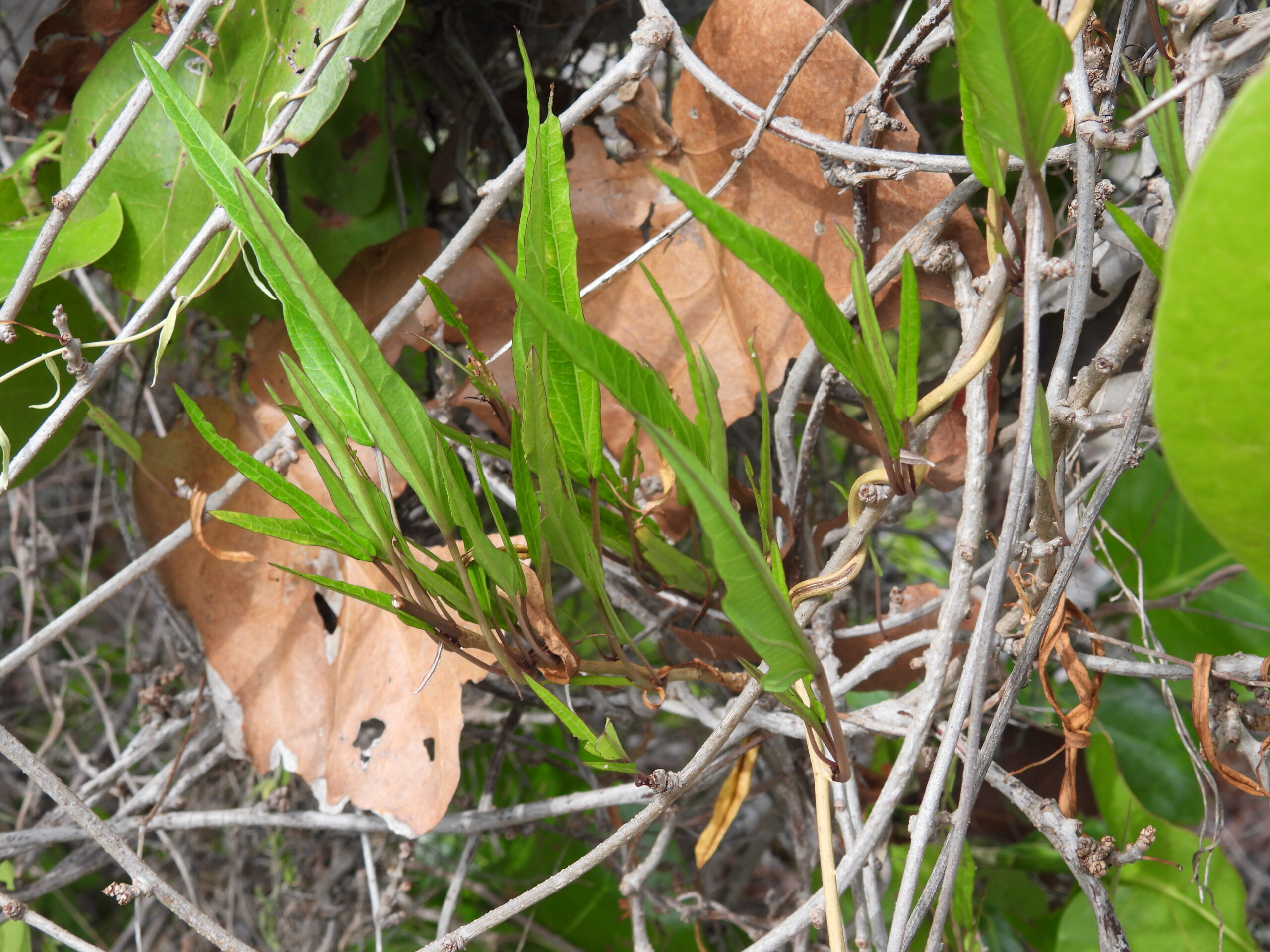

Habit: Ipomoea sagittata grows as a pubescent vine to 8 m in height. Leaves arranged alternately, elongate, sagittate to hastate, to 15 cm in length, with an entire margin, an acuminate/mucronate leaf apex and an elongated lobed leaf base.
The complete, perfect, actinomorphic flowers are arranged in cymes/panicles. The calyx has 5 unfused, green sepals. The salverform corolla has 5 fused, purple to lavender petals with a darker center that are slightly enlarged at the base. There are 5 functional stamens fused to the base of the corolla. The superior ovary with 3 locules and numerous ovules. The fruit is a ribbed, many seeded capsule with pubescence along the edges.
Habitat: Ipomoea sagittata grows in Human Altered environments (yards and gardens).
Distribution: Ipomoea sagittata occurs sparingly throughout the Lucayan Archipelago. It is native to the Caribbean region and Central America, the southern United States. It has been spread throughout the world as an ornamental species.
Medicinal/Cultural/Economic Usage: Ipomoea sagittata is not known to be used medicinally in the Lucayan Archipelago.