
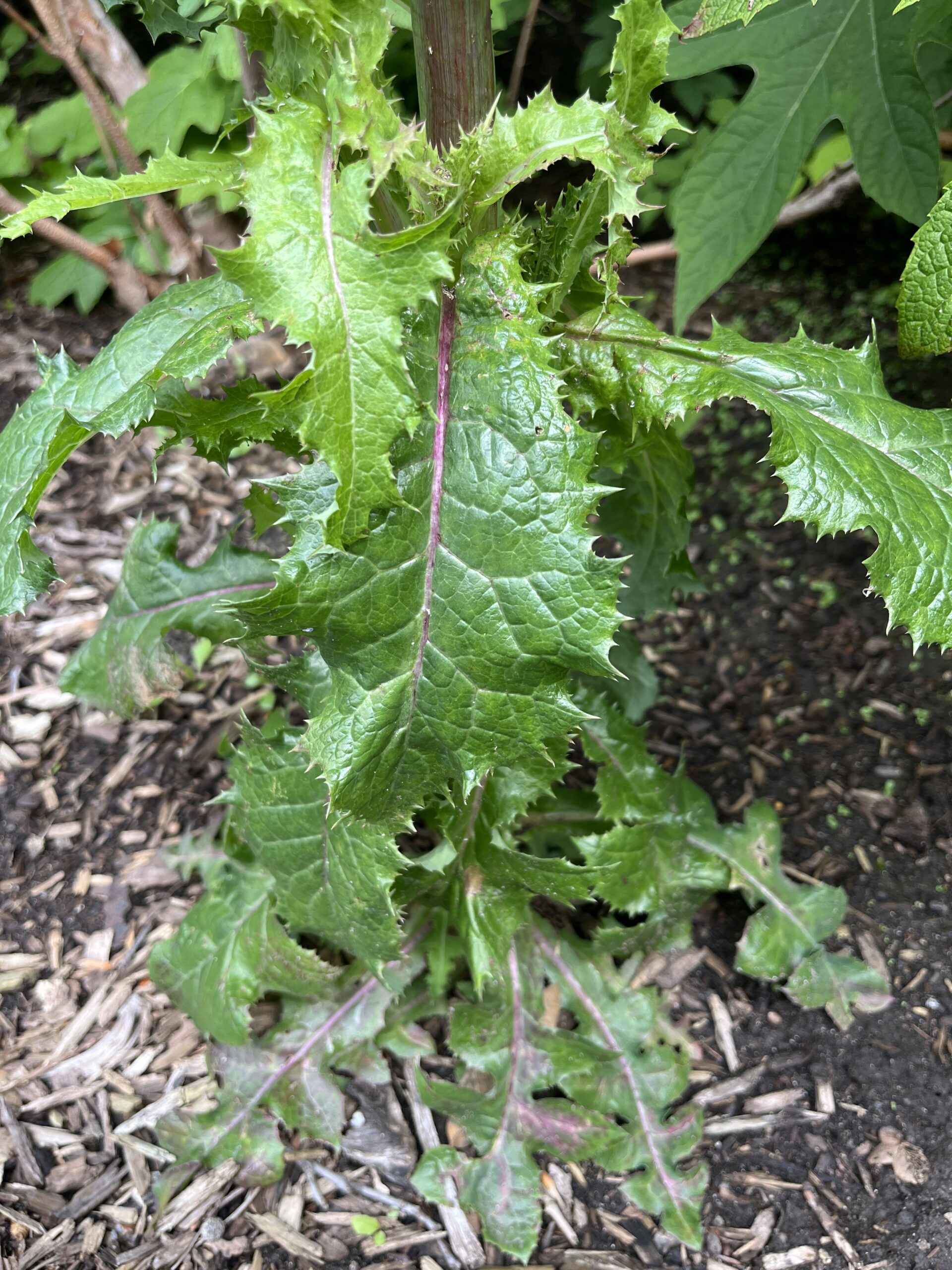
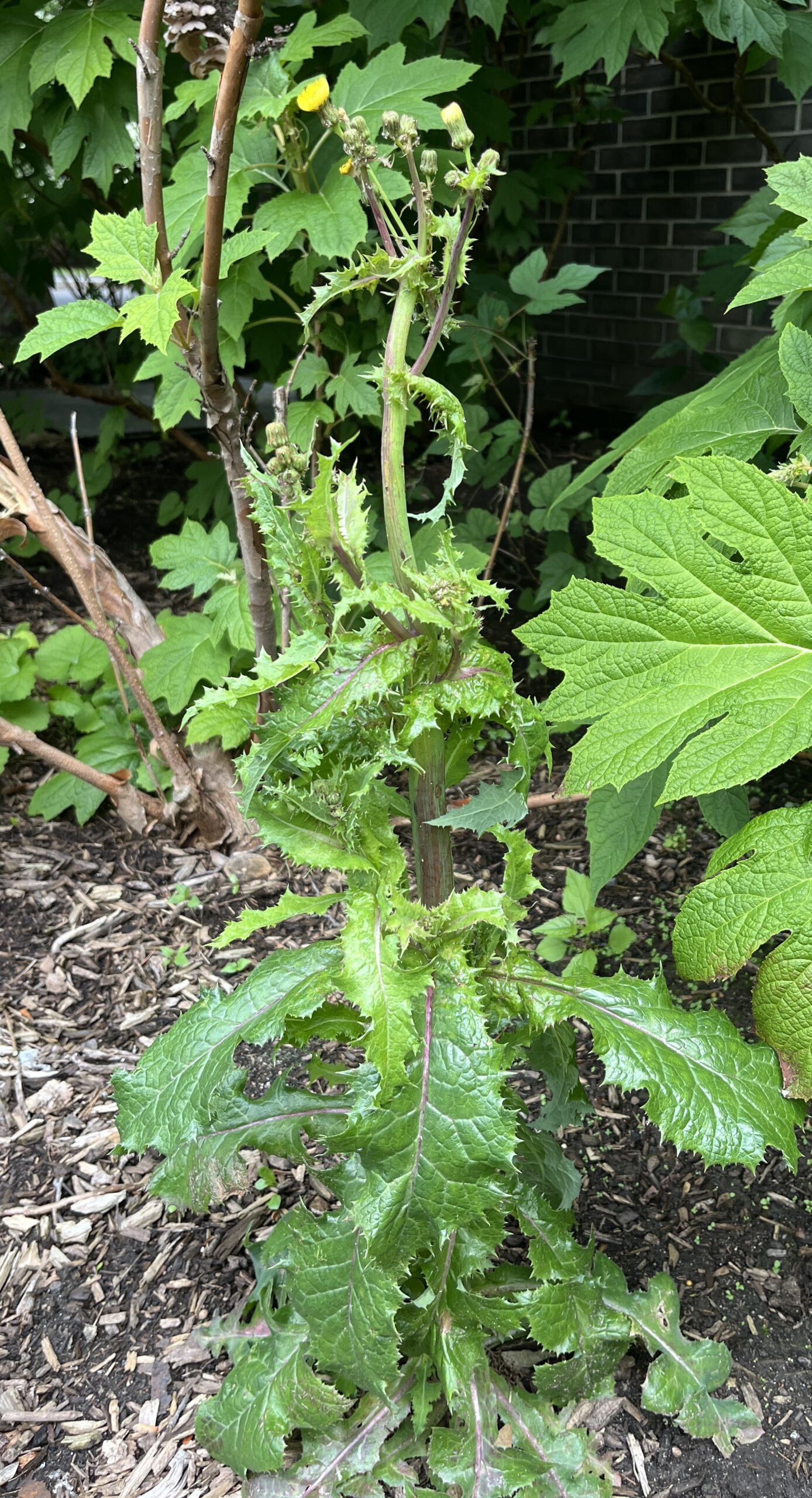
Habit: Sonchus asper grows as an annual or biennial to 2 m in height when in flower. The leaves are arranged alternately, to 16 cm in length, pinnatifid/dentate/lobed/spiny leaf margin and abaxial surface, ovate to oblanceolate with an acuminate leaf apex. The petiole surrounds the node forming a sheath/auricle. Stalks have a milky sap.
The flowering stalks are cymes to panicles terminating in heads. The heads are subtended by 2-3 series of involucral bracts (phyllaries) that are up to 2 cum in length. The calyx is modified as a ring of hairs (pappus). There are only perfect (disc) flowers. Each flower is subtended by a bract.
The perfect, zygomorphic flowers have a corolla with 5 fused, yellow petals. There are 5 stamens fused at their base. The ovary is inferior with a single locule and ovule. The fruit is a ribbed achene at maturity that retains the modified calyx (pappus) as white, hairlike bristles.
Habitat: Sonchus asper grows in Human Altered environments (yards, gardens, fields, waste areas, roadsides).
Distribution: Sonchus asper is NOT native to the Lucayan Archipelago. It is native to Asia, North Africa, and Europe but is distributed worldwide as an introduced weed. Within the Bahamas it is found on northern islands occasionally.
Medicinal/Cultural/Economic usage: Sonchus asper is not known to be used medicinally in the Lucayan Archipelago.
The leaves are known to be edible.