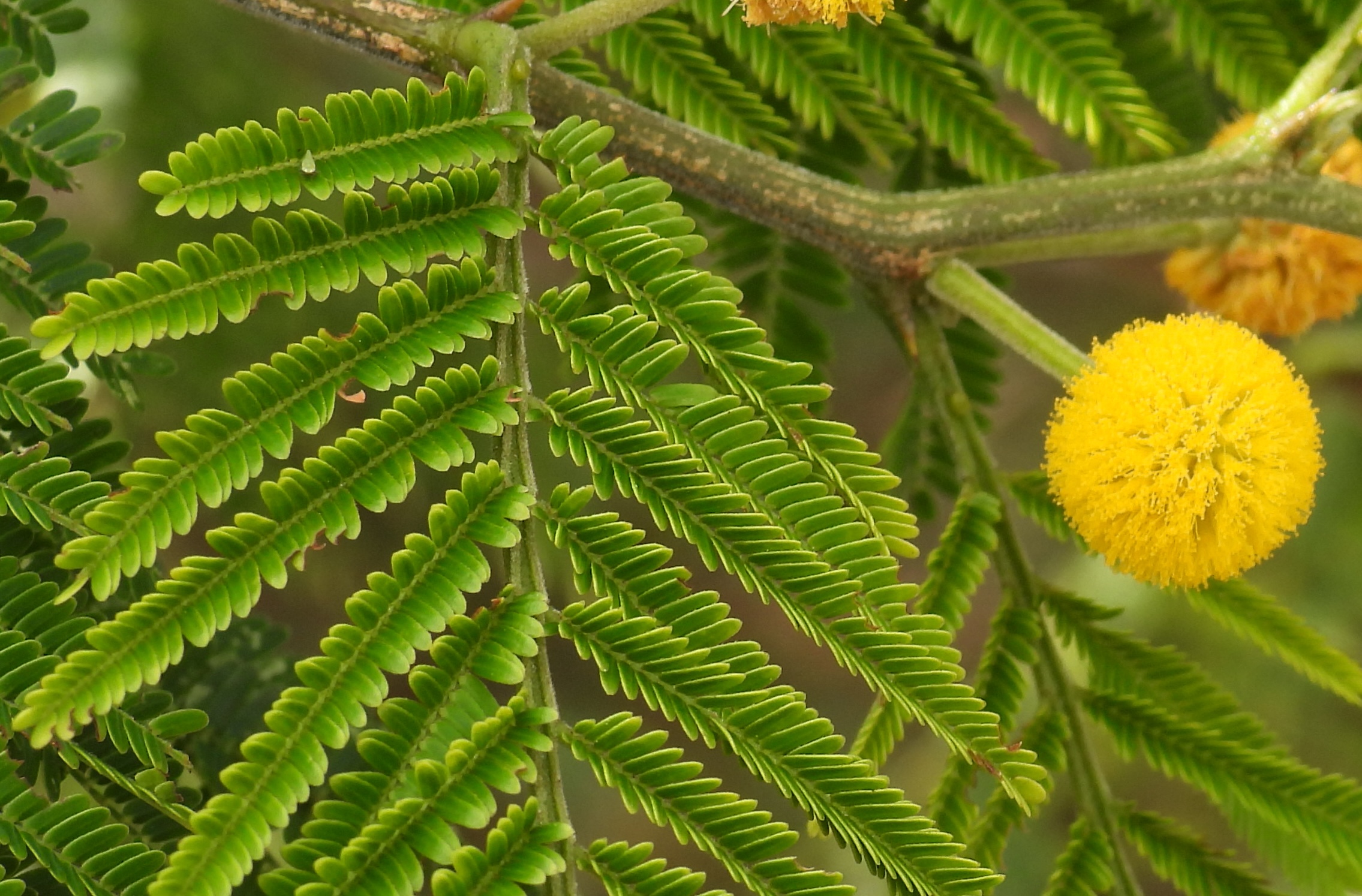


Habit: Vachellia macracantha grows as a small tree/large shrub to 10 m in height. The trunk is dark brown to almost black with fissures exposing lighter bark and exuding resin. There are stipular spines in pairs to 9 cm in length. The petiole has a cup-shaped to domed gland. The bipinnate leaves are arranged slightly alternately. There are 30-40 pairs of pinnae each with 16-20 pairs of linear to oblong leaflets with an entire margin. The rachis and petiole are grooved.
The complete, perfect, actinomorphic flowers are arranged in tight, axillary or terminal, globular heads with each flower subtended by a bract. There are 5 fused sepals in the calyx forming a shallow tube. There are 5 fused petals in the corolla forming a tube that exceeds the calyx. There are numerous yellow showy stamens that are 2 times as long as the perianth. The ovary is superior with a single locule. The fruit is a flattened oblong legume that turns brown at maturity, is up to 12 cm in length.
Habitat: Vachellia macracantha grows at the edges Dry Broadleaf Evergreen Formations – Forests/Shrublands and in Human Altered environments (yards, abandoned fields, roadsides).
Distribution: Vachellia macracantha is native to the Lucayan Archipelago, Central and South America and in southern Florida and Mexico. In the Bahamas it primarily occurs in the southern islands
Medicinal/Cultural/Economic usage: Vachellia macracantha is not known to be used medicinally in the Bahamas.
Vachellia macracantha has been used for fire wood and is a known nitrogen fixer.